
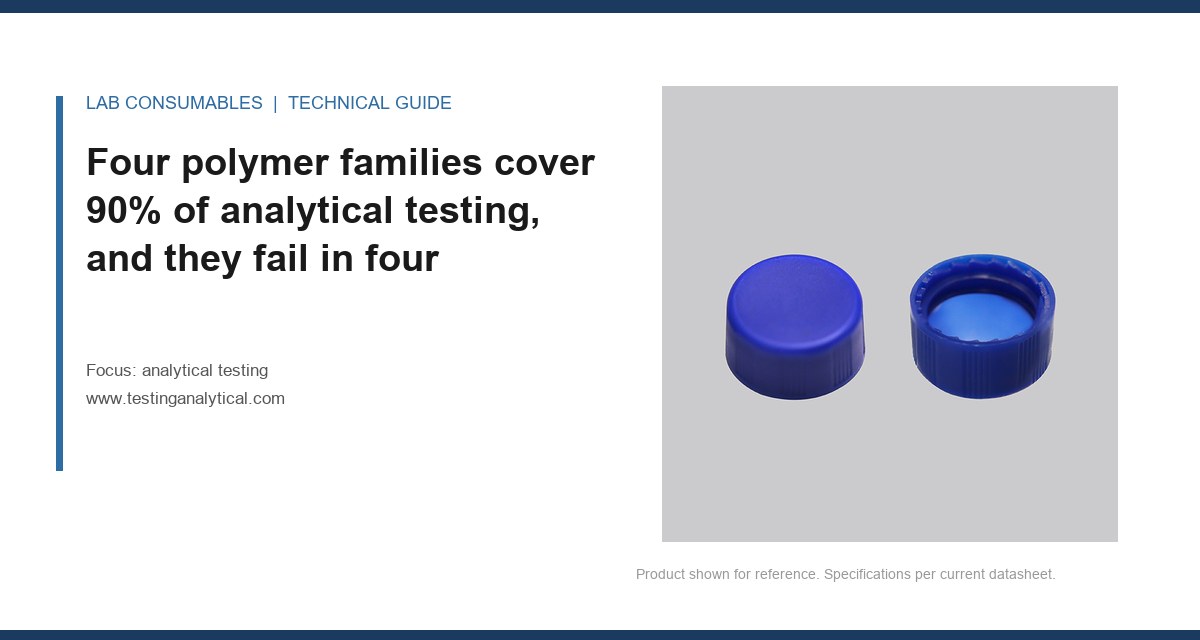
A 12-position autosampler tray ran 96 injections of a method using 30% acetonitrile in 0.1% TFA at 40 °C. By injection 60, peak areas for the internal standard had drifted 11.4% below the start, and the system suitability RSD on five replicates had climbed from 0.6% to 3.8%. The column was new. The detector lamp had 1,800 hours on it. What had changed was the vial lot: the previous lot used a silicone/PTFE septum, the new one used a plain silicone septum because the distributor was out of the laminated version. Silicone is a fine septum for a lot of work. It is not a septum for a 40 °C tray sitting over acetonitrile for eight hours, and this article is about how to know that before you buy the wrong one.
The core question, when you strip the sales literature away, is this: which analytical testing material goes with which solvent at which temperature. That is the whole decision. Everything else (dimensions, fit, pricing) is downstream and covered elsewhere on this site. What follows is the polymer-by-polymer behaviour against the solvents and temperatures you actually run, and the specific failure each wrong pairing produces.
Four polymer families cover 90% of analytical testing, and they fail in four different ways
PTFE, silicone, EPDM, and laminate (PTFE-faced silicone, or PTFE-faced EPDM) are the four materials you will specify for septa, cap liners, ferrules, tubing, and sample-path components. They are not interchangeable. Each one has a solvent window, a pH window, and a temperature ceiling, and each one fails by a mechanism you can recognise from the symptom.
Here is the working comparison. I have kept the numbers to what I have measured or what the manufacturers publish, and I have flagged where the two disagree.
| Property | PTFE (virgin, unfilled) | Silicone (platinum-cured) | EPDM | PTFE-faced laminate |
|---|---|---|---|---|
| Continuous service temp (upper) | 260 °C | 200 °C (225 °C short) | 150 °C (120 °C in hot water/steam) | 200 °C (silicone core limits) |
| Continuous service temp (lower) | -200 °C | -60 °C | -50 °C | -60 °C |
| pH range | 0 to 14 | 3 to 9 (hydrolyses outside) | 1 to 13 | 0 to 14 on the wetted face |
| Resistance to acetonitrile, methanol, THF, DMSO | Excellent | Poor to fair (swells, extracts) | Good for polar aprotic, fair for THF | Excellent (face protects core) |
| Resistance to hexane, toluene, DCM | Excellent | Poor (swells badly) | Poor (swells badly) | Excellent |
| Resistance to aqueous acid/base | Excellent | Fair (hydrolyses at pH extremes) | Excellent | Excellent |
| Puncture count (23G needle, 0.6 mm) | 1 to 3 (cold flows) | 50 to 100 | 30 to 60 | 50 to 100 (face), core limits |
| Reseal after puncture | Poor (cold flow, no elastic memory) | Excellent | Good | Good (silicone core reseals) |
| Extractables profile | Very low (but can shed particles) | High (oligomers, siloxanes, curing agents) | Moderate (antioxidants, cure residues) | Low on wetted face |
| Typical failure mode | Cold flow, coring, particle shedding | Swelling, extraction, hydrolysis, ghost peaks | Swelling in nonpolar, compression set | Delamination, core extrusion at high temp |
Read that table as a starting point, not a datasheet. The numbers are typical of unfilled, virgin grades. Filled grades (glass-filled PTFE, carbon-filled EPDM) shift the ceilings and change the extractables profile, sometimes for the worse. If your vendor cannot tell you whether the grade is filled, ask. A glass-filled PTFE ferrule in an HPLC injector will shed glass and score a valve rotor.
PTFE is the default that most labs over-specify, and that costs them coring
PTFE is chemically inert against essentially everything you will put through an HPLC or GC. It handles pH 0 to 14, it takes 260 °C continuously, and it does not extract into your mobile phase. That is why it is the default face material on septa and the default ferrule material in GC inlets. The problem is what PTFE does mechanically.
PTFE cold-flows. Under the compression of a crimp cap, it deforms permanently over hours, which means the seal relaxes and the vial loses its headspace pressure. Under a needle, it does not reseal: a 23G needle leaves a hole that stays open. In practice, a pure PTFE septum is good for 1 to 3 punctures before it leaks, and a leaking septum in a headspace vial or an autosampler tray means solvent evaporates, concentration rises, and your peak areas climb. I have seen a 6% area increase across a 48-hour tray sit purely on PTFE septum relaxation, not on instrument drift.
PTFE also sheds. Virgin PTFE has a low coefficient of friction, which is good for a ferrule, but it also means the material can smear and generate particles under repeated compression. In a GC inlet, a PTFE ferrule that has been over-torqued will extrude into the liner and eventually into the column, and you get a baseline rise that looks like column bleed. It is not column bleed. It is a ferrule that was tightened past its yield.
Where PTFE belongs: GC inlet ferrules (with the correct torque, typically 1/4 to 1/2 turn past finger-tight for a 1/16-inch graphite/PTFE ferrule, and never more), pump seals in HPLC, tubing for aggressive mobile phases, and the wetted face of a laminate septum. Where it does not belong: a septum that will be punctured more than a handful of times, or a cap liner on a tray that sits for hours under a volatile solvent.
Silicone reseals beautifully and extracts into your chromatogram
Silicone is the opposite trade. Platinum-cured silicone has excellent elastic memory: a 23G needle puncture reseals and holds pressure, and a good silicone septum takes 50 to 100 punctures before it fails. That is why it is the core of most laminated septa. But silicone is not inert. It swells in nonpolar solvents (hexane, toluene, DCM) and it extracts in polar aprotic ones (acetonitrile, DMSO, THF).
The extraction is the part that bites analytical chemists. Silicone oligomers (cyclic siloxanes, typically D4 through D8) show up as ghost peaks in GC-MS at m/z 73, 147, 207, 281, and 355. If you are running a method with a silicone septum and a polar solvent at elevated temperature, you will see those peaks, and they will not be in your blank because the blank was run with a fresh vial and a different septum lot. The peaks appear in samples, not blanks, because the solvent is what extracts the oligomers.
Silicone also hydrolyses. Outside pH 3 to 9, the siloxane backbone breaks down, and you get a sticky residue on the septum face that looks like a leak but is not. In a headspace vial at 80 °C with a pH 2 buffer, a plain silicone septum will degrade within a few hours. The symptom is a slow loss of headspace pressure and a rising internal standard response, not a visible leak.
Where silicone belongs: the core of a laminate septum, septa for aqueous mobile phases at neutral pH and moderate temperature, and any application where puncture count matters more than extractables. Where it does not: direct contact with acetonitrile, DMSO, THF, or any nonpolar solvent, and any method with a pH outside 3 to 9.
EPDM handles the pH extremes silicone cannot, and swells in the solvents PTFE ignores
EPDM (ethylene propylene diene monomer) is the polymer most labs under-use. It handles pH 1 to 13, which covers the acidic and basic buffers that destroy silicone, and it takes 150 °C continuously (drop to 120 °C in hot water or steam, where EPDM is less happy). It is the right material for aqueous methods at extreme pH: a pH 1.5 phosphate buffer, a pH 12 carbonate buffer, a strongly basic mobile phase for a reversed-phase method.
But EPDM is a hydrocarbon rubber. It swells in nonpolar solvents the same way silicone does, and it is worse in some aromatics. A toluene-based mobile phase will swell an EPDM septum by 20% or more within an hour, which pushes the septum out of the cap and produces a leak that looks like a crimp failure. EPDM also has a compression set problem: under sustained compression at temperature, it takes a permanent set and stops sealing. A tray that runs at 60 °C for eight hours will show EPDM septa that no longer hold pressure by the end of the run.
Where EPDM belongs: aqueous mobile phases at pH outside 3 to 9, buffer-heavy methods, and any application where silicone would hydrolyse. Where it does not: nonpolar solvents, aromatic mobile phases, and any long tray run at elevated temperature where compression set matters.
Laminate is the compromise, and the compromise has a failure mode of its own
A PTFE-faced laminate (PTFE film bonded to a silicone or EPDM core) is the standard answer for autosampler septa because it puts the inert face against the sample and the elastic core against the needle. The face handles the solvent and the pH; the core handles the puncture and the reseal. For a 40 °C tray running 30% acetonitrile, a PTFE/silicone laminate is the correct choice, and it is what the failed run in the opening should have been using.
The laminate fails in two ways. First, delamination: if the bond between the PTFE face and the core is poor, the face lifts at the puncture site and the solvent reaches the core. You see this as a sudden increase in siloxane peaks after 20 or 30 injections on the same vial, not from the first injection. Second, core extrusion: at temperatures above 200 °C, the silicone core softens and extrudes through the cap hole, and the septum no longer seals. This is why laminate septa are rated to 200 °C and not to the 260 °C of the PTFE face alone.
The laminate is also where the “which material” question gets answered by the supplier’s bonding process, not by the polymer datasheet. Two laminates with identical polymer specs can behave differently because one has a 25 µm PTFE face and the other has a 50 µm face, or because one is bonded with a primer that extracts. Ask for the face thickness and the bond method. A 50 µm face is more robust to puncture; a 25 µm face is more flexible and seats better on an uneven cap.
The solvent-temperature-pH matrix is the decision, and it fits on one page
Here is the decision rule I use. It is not a substitute for a compatibility test, but it eliminates 90% of wrong choices before you buy.
- Nonpolar solvent (hexane, toluene, DCM, chloroform) at any temperature: PTFE or PTFE-faced laminate. Never silicone, never EPDM.
- Polar aprotic solvent (acetonitrile, DMSO, THF, DMF) below 60 °C: PTFE-faced laminate. Plain silicone only if puncture count is the binding constraint and you accept the ghost peaks.
- Polar aprotic solvent above 60 °C: PTFE-faced laminate with a verified bond, or PTFE if puncture count is low. Check for delamination at 20 to 30 injections.
- Aqueous mobile phase, pH 3 to 9, below 80 °C: silicone or PTFE/silicone laminate. This is the one place plain silicone is fine.
- Aqueous mobile phase, pH outside 3 to 9: EPDM or PTFE-faced EPDM laminate. Silicone will hydrolyse.
- Any method above 150 °C: PTFE only. Laminate cores soften; EPDM sets.
- Headspace at 80 °C or above with a volatile solvent: PTFE-faced laminate, and check the crimp torque. A loose crimp at 80 °C loses more sample than a bad septum.
That matrix is the answer to the primary intent. If you take nothing else from this article, take the matrix and the failure modes that go with each row. The rest is how to verify that the material you bought is the material you specified.
Two field cases where the polymer was the diagnosis
Case 1: the drifting internal standard was a swelling septum
A contract lab running a USP method on a basic drug (pH 10.5 carbonate buffer, 55 °C tray) saw the internal standard response fall 9% across a 72-hour sequence. The instrument was requalified; the column was replaced; the drift persisted. The measurement that identified it was a simple one: they weighed 10 septa before and after 24 hours in the mobile phase at 55 °C. The silicone septa had gained 14% mass. The EPDM septa gained 2%. The fix was a switch to PTFE-faced EPDM laminate, and the drift dropped to 1.2% over the same 72 hours. The lesson is that a basic buffer at 55 °C is outside silicone’s pH window, and no amount of instrument requalification fixes a polymer that is hydrolysing in the cap.
Case 2: the ghost peaks were a laminate bond failure
A GC-MS lab running EPA method 8260 (volatile organics) saw siloxane peaks at m/z 73 and 207 appear after injection 25 on each vial, not from injection 1. The blank was clean. The measurement that identified it was a puncture-count test: they ran the same vial to 40 injections and plotted the siloxane peak area against puncture number. The area was flat to injection 22, then rose sharply. That is the signature of a PTFE face that has worn through at the puncture site and exposed the silicone core. The fix was a laminate with a thicker face (50 µm instead of 25 µm) and a switch to a fresh vial every 20 injections for that method. The peaks did not return.
Both cases share a pattern: the failure was not visible, it was measurable, and the measurement was cheap. A balance and a puncture-count run will tell you more about a septum lot than any datasheet.
What to ask before you specify, and what to measure after
Before you buy, ask the supplier four questions. What is the base polymer and is it filled? What is the face thickness on the laminate? What is the bond method? What is the extractables profile in the solvent you will use? A supplier who cannot answer the third question is selling a laminate they did not make.
After you buy, run a three-point verification. Weigh 10 units before and after 24 hours in your mobile phase at your tray temperature; a mass gain above 5% means the polymer is swelling and you have the wrong material. Run one vial to 40 punctures and plot your target peak area against puncture number; a step change tells you the face or the core has failed. And run a blank with the new lot against the old lot; any new peak at m/z 73, 147, 207, or 281 in GC-MS is silicone, and any new peak in the 200 to 400 m/z range in LC-MS is likely an antioxidant or cure residue from EPDM.
If you are running a regulated method, the material specification belongs in your method file, not in a purchasing note. EPA SW-846 methods and the equivalent ISO and AOAC procedures assume the consumable is part of the method, and an auditor who asks “what septum did you use” expects a part number and a lot number, not “the one that was in the drawer.” The EPA SW-846 test methods are explicit that sample integrity includes the container. The same logic applies to your vial and cap specification.
The decision rule
Match the polymer to the solvent first, the pH second, and the temperature third, and never let puncture count override solvent compatibility. PTFE for nonpolar and high temperature, silicone only for neutral aqueous below 80 °C, EPDM for pH extremes in aqueous systems, and a PTFE-faced laminate as the default for autosampler trays running polar aprotic solvents. If the solvent and the temperature disagree about the material, the solvent wins. That single rule will keep you out of the failure modes in this article, and it is the rule I would put on the wall above the consumables cabinet.
For the wider consumable and workflow context, see analytical testing at testinganalytical.com. For the vial and cap specification that goes with the septum choice, HPLC vial at vialforhplc.com and lab vials at labvials.com cover the dimensional and fit side. For the broader consumables catalogue, chromatography consumables at chromatographyconsumables.com is the starting point. For manufacturer technical data on septa and ferrules, Agilent’s GC columns and accessories and Thermo Fisher’s chromatography and sample handling pages publish the temperature and solvent ratings, and Restek’s technical resources have the extractables data that most datasheets leave out.
References & further reading
Related resources from our lab consumables network:
- Analytical Testing at testinganalytical.com
- Hplc Vial at vialforhplc.com
- Chromatography Consumables at chromatographyconsumables.com
- Lab Vials at labvials.com
External references and standards: