
The 200 mg lot of C18 packing passed the vendor’s certificate and our release check. Three weeks later the same method on the same column lot gave a 1.9% tailing factor drift on a moderately basic analyte and retention shifted by 0.4 minutes, enough to push a critical pair from 1.6 to 1.3 resolution. Nothing in the run had changed. What changed was the lot. That is the failure mode this article is about: analytical testing lot-to-lot variation that hides in a certificate until the run is already committed, and the cheap incoming inspection that catches it in fifteen minutes instead of fifteen days. If you buy consumables by part number and trust the CoA, you have no early warning system. You have a receipt.
The core problem is that most labs treat incoming inspection as a receiving-dock function: count the boxes, confirm the part number, file the certificate. That inspection tells you the supplier shipped what you ordered. It does not tell you whether the material will perform the same way next Tuesday. Lot-to-lot variation is a manufacturing reality, not a defect. Molds wear, polymer lots differ, silane batches age, and the drift is usually inside the supplier’s own spec. The question is whether it is inside yours.
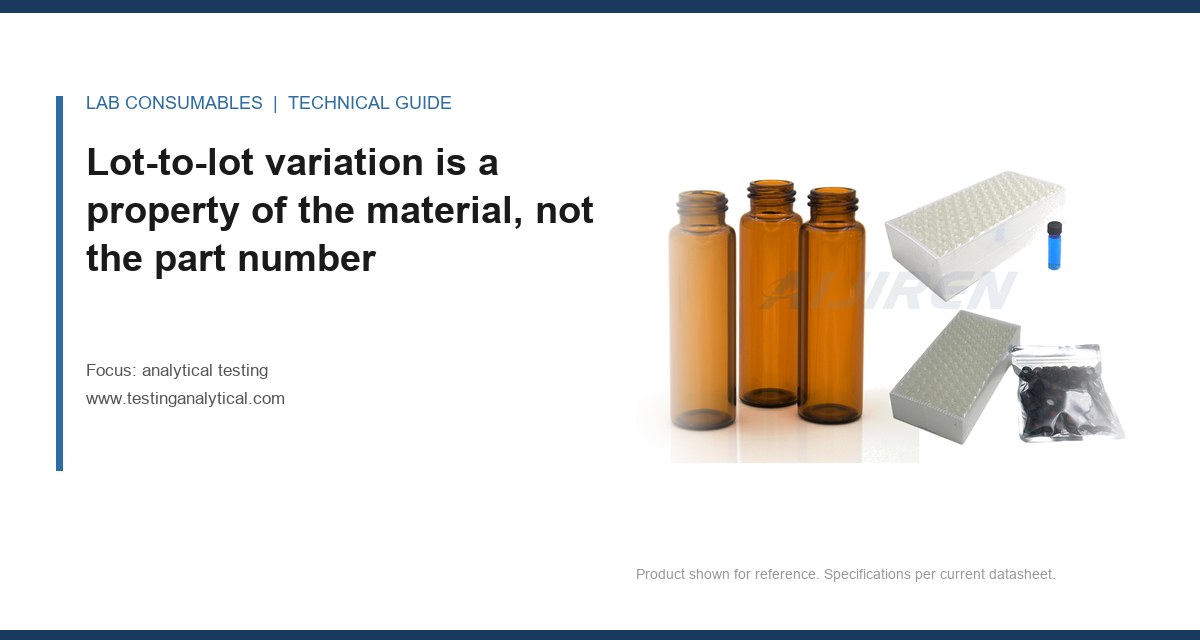
Two vials with the same catalog number from the same supplier in the same year can differ in ways that matter analytically. The part number controls the drawing. The drawing controls dimensions and material class. It does not control the things that actually move a chromatogram: surface silanol activity on glass, residual mold release, extractables load, silane coverage on packing, and the dimensional scatter that comes from a cavity wearing past its nominal. I have watched a 2 mL crimp vial from a new cavity run 0.3 mm short at the neck, which changed the crimp seal geometry and produced a slow leak on a 12-position autosampler over a 40-hour sequence. The certificate was clean. The dimensions were in spec. The leak was real.
This is why incoming inspection has to test the parameters that drift, not the parameters that are easy to measure. Weight, appearance, and a pass stamp on the CoA are the easy ones. They catch almost nothing that matters. The parameters that drift between lots are narrower and more specific, and they differ by product family. Get the list right and the test gets cheap.
The parameters that actually drift between lots
I have grouped these by product family because that is how you build the inspection. A single universal checklist wastes time on the wrong test. The drift lives in different places depending on what you are buying.
Vials and closures
- Neck and crimp geometry. Crimp vial neck OD and the bead that the seal deforms against. A 0.2 to 0.4 mm shift in neck OD changes the crimp force needed for a gas-tight seal. This is the single most common source of slow leaks and evaporation in long sequences. If you run HPLC vials on a 96-hour autosampler method, neck geometry is the first thing to check.
- Glass surface chemistry. Borosilicate Type I is not uniform. Residual surface silanols and trace metals adsorb basic analytes. A lot with higher surface activity shows up as peak tailing on amines and a lower recovery on low-concentration standards.
- Septum formulation and durometer. Silicone vs. silicone/PTFE, and the durometer of the silicone. A harder septum resists coring but requires more crimp force. A softer one seals easily and cores. Puncture count before coring is a real number: good septa hold 3 to 5 punctures on a single injection port before the hole stops resealing. A lot that cores at 2 is not the same product.
- Extractables. Mold release, plasticizers from caps, and residual manufacturing oils. These show up as ghost peaks in blank runs, especially on sensitive LC-MS methods.
Chromatography columns and packing
- Retention and selectivity. The two numbers that decide whether your critical pair resolves. A shift of 0.3 to 0.5 minutes in retention on a new lot is normal; a shift that moves resolution below 1.5 is not.
- Tailing factor on basic analytes. The canary for silanol activity and endcapping quality. A drift from 1.1 to 1.4 on a probe base is a lot problem, not a method problem.
- Pressure and permeability. A lot packed at a different bed density runs at a different backpressure. A 10 to 15% backpressure shift on the same method and temperature is worth investigating before you blame the pump.
- Particle size distribution. The nominal is 5 µm or 3 µm; the distribution width controls efficiency. A wider distribution drops plate count.
Filters, syringes, and sample prep consumables
- Membrane lot and pore integrity. A different membrane cast can change analyte binding, especially for proteins and hydrophobic compounds. Recovery on a 0.22 µm PVDF or PTFE filter can swing several percent between membrane lots.
- Housing and O-ring material. Extractables from housing plastics and lubricants. Same ghost-peak problem as vial caps.
- Holding volume and dead volume. A filter with a larger hold-up volume dilutes small samples more. On a 100 µL sample this is measurable.
Reference standards and reagents
- Purity and assay value. The certificate value is a measurement with uncertainty. A standard certified at 99.2% vs. 98.6% changes every calculated result by the ratio, and the shift is silent unless you track it.
- Water content and residual solvents. Affects weighing and concentration.
- Salt form and hydration state. A hydrate vs. anhydrous lot changes the molecular weight you divide by.
Notice what is on that list and what is not. Particle count, visual defects, and label accuracy are not there because they rarely move a result. If your incoming inspection spends its time on those and skips neck geometry, septum durometer, and blank-run extractables, it is inspecting the box, not the product. The chromatography consumables that carry the most risk are the ones in direct contact with the sample at the smallest volumes.
The fifteen-minute incoming test that catches most of it
You do not need a full method validation on every lot. You need a small, fixed, boring test that runs the same way every time and produces a number you can trend. The design principle is: test the material in the way the method uses it, at the smallest scale that still produces a signal. Here is the test I run, and it fits in a single sequence on one instrument.
The system suitability blank and probe injection
Run a method blank through the new lot of vials, septa, and filters, then a single probe standard. The blank catches extractables and ghost peaks. The probe catches surface activity and recovery. Use a mildly basic probe (a small amine) if your method has any basic analytes, because that is where surface chemistry shows up first. Record three numbers: the largest blank peak area, the probe tailing factor, and the probe recovery vs. the previous lot.
The dimensional spot check
Pull 10 units from the lot. Measure neck OD, overall height, and crimp bead diameter with a caliper or, better, a go/no-go gauge. Compare the mean and the range to the previous lot, not just to the drawing. A lot that is in spec but at the edge of the spec is a lot that will fail on your autosampler even though it passed the supplier’s. This is the same dimensional stack logic that decides whether a vial fits at all, applied as a trend rather than a pass/fail. If you buy through lab vials channels, ask for the cavity and lot code on the carton so you can trend by cavity, not just by lot.
The septum puncture test
Puncture the same septum 5 times with the same needle gauge your autosampler uses, then pressure-test or run a blank through it. Count the punctures before the seal fails. A lot that fails at 2 instead of 4 will leak on long sequences. This takes ten minutes and has saved me more 40-hour runs than any other single test.
The column lot probe
For a new column lot, inject a defined probe mix at a fixed temperature and flow. Record retention of the first and last peaks, the resolution of the critical pair, tailing on the base, and backpressure. Compare to the previous lot with a control chart, not a single pass/fail. A 0.4-minute retention shift is fine if resolution holds; it is not fine if it does not. The full working principle and selection criteria for columns are covered well in vendor technical resources such as Restek’s chromatography reference material and the Agilent GC column and accessory documentation; use those to set your probe conditions, then keep the conditions fixed forever.
Set the acceptance band from your method, not the supplier’s spec
The single biggest mistake in incoming inspection is accepting the supplier’s spec as your acceptance criterion. The supplier’s spec is built to ship product. Your acceptance band is built to protect the method. They are different numbers, and the gap is where failures live. Build the band from the method’s tolerance, then back-calculate how much lot drift you can absorb.
| Parameter | Typical lot drift | Method tolerance (example) | Incoming acceptance band I use |
|---|---|---|---|
| Vial neck OD | ±0.2 to 0.4 mm | Seal must hold 40 h | Within 0.15 mm of prior lot mean |
| Septum punctures to failure | 2 to 5 | Method uses 1 puncture | ≥ 3 before coring |
| Column retention (probe) | ±0.3 to 0.5 min | Resolution ≥ 1.5 | Resolution ≥ 1.7 on probe |
| Column tailing (base probe) | 1.1 to 1.4 | USP tailing ≤ 2.0 | ≤ 1.3 |
| Blank peak area (LC-MS) | 2x to 10x | Below LOQ | ≤ 3x prior lot blank |
| Filter recovery | ±2 to 5% | Recovery 90 to 110% | Within 2% of prior lot |
| Standard assay value | ±0.5 to 1.0% | Result within 2% of true | Re-certify if shift > 0.3% |
That table is the decision checklist. If a lot lands outside the band on any row, it does not go into the run. It goes to a confirmatory test or back to the supplier, and the commercial conversation happens after the analytical decision, not before. The point of the band is to make the decision mechanical so it does not depend on who is on shift.
Two field cases where the measurement found the lot
Case 1: The 40-hour sequence that leaked at hour 31
Symptom: A stability study on a 40-hour autosampler sequence lost the last eight timepoints on the highest-concentration standard. The peaks were low and variable, not absent. The instrument was fine. The method was unchanged.
Measurement: I weighed 10 vials from the current lot and 10 from the previous lot before and after the sequence. The current lot lost an average of 1.8 mg per vial over 40 hours vs. 0.3 mg for the previous lot. The neck OD on the current lot ran 0.25 mm under the previous lot mean, and the crimp seal was not fully engaging the bead. The certificate was clean because the dimension was inside the drawing tolerance.
Fix: Added neck OD to the incoming dimensional spot check with a band of ±0.15 mm against the prior lot mean, and added a 10-vial weight-loss check over 24 hours for any lot going into a sequence longer than 12 hours. The weight-loss test takes one balance and one day and catches the leak before the run does.
Case 2: The column lot that passed release and failed the critical pair
Symptom: A new lot of the same C18 column, same part number, gave a resolution of 1.3 on a critical pair that had been 1.6 for two years. System suitability failed on the first injection of the first run.
Measurement: The probe injection showed retention shifted 0.4 minutes later and tailing on the base probe moved from 1.15 to 1.38. Backpressure was 12% higher. The lot had a different bed density and slightly more surface silanol activity. All three numbers were inside the supplier’s spec.
Fix: Set an incoming probe acceptance band of resolution ≥ 1.7 and tailing ≤ 1.3 on the probe mix, run before the lot is released to the method. The first lot that failed the new band was caught at incoming and never entered a production run. The method itself was not changed. The lesson: the supplier’s release test is not your release test, and the probe mix is the cheapest way to translate one into the other.
Build the trend, not the pass stamp
A single incoming test on a single lot tells you almost nothing. The value comes from the trend. Plot each parameter against lot number on a control chart with the prior 10 to 20 lots as the baseline, and set the action limit at the band from the table above. A lot that is two standard deviations from the baseline mean is a lot to look at, even if it passed the band. The drift that sinks a method is usually a series of small in-spec moves, not one dramatic failure. If you only ever see pass/fail, you will see the failure after it has already cost you a run.
Keep the incoming test method frozen. Same probe mix, same temperature, same flow, same needle gauge, same balance. The moment you “improve” the test, you break the trend and lose the baseline. This is the same discipline that makes any analytical testing program defensible: the measurement is only useful if it is repeatable enough to compare across time. For methods that fall under regulatory frameworks, the incoming test is not a regulated method and does not need full validation, but it does need to be documented and controlled. The EPA SW-846 framework and vendor method documentation from Thermo Fisher’s chromatography resources are useful references for how to structure a controlled, repeatable test even when the test itself is in-house.
What to do when a lot fails the incoming band
Do not put it into the run and hope. Do not average it against the previous lot. Quarantine the lot, run the confirmatory test (a full system suitability on the actual method), and if it still fails, hold it and start the supplier conversation. The commercial side is a separate article; the analytical decision is simple: a lot outside your band is a lot that has not earned a place in your method. The cost of holding a lot for a day is trivial next to the cost of a failed 40-hour sequence, a repeated stability study, or an out-of-specification investigation that traces back to a vial neck you never measured.
The decision rule is this: every consumable lot gets a fifteen-minute incoming test on the parameters that drift for its product family, measured against a band derived from the method’s tolerance, trended on a control chart, and frozen so the trend stays comparable. If a lot is outside the band, it does not enter the run. The certificate is a claim. The incoming test is the measurement. Trust the measurement.
References & further reading
Related resources from our lab consumables network:
- Analytical Testing at testinganalytical.com
- Hplc Vial at vialforhplc.com
- Chromatography Consumables at chromatographyconsumables.com
- Lab Vials at labvials.com
External references and standards: