
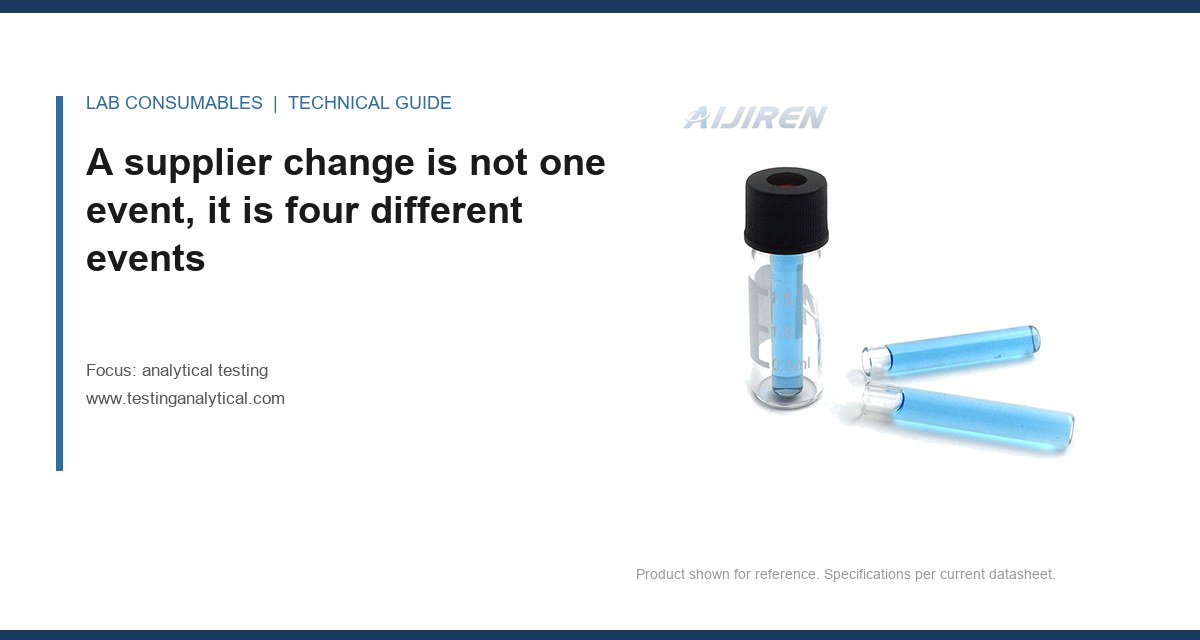
A lot of 40 mL VOC vials came in with septa from a different molding cavity, and the first thing we noticed was not a leak. It was the internal standard area counts on a purge-and-trap run dropping 18% against the previous lot, with retention time on the early eluters moving 0.04 min late. Nothing on the instrument had changed. The method was still validated. The question the lab manager asked me was the right one: does this force revalidation, or do we verify and move on? That question, and how you write the answer into change control so an inspector signs off on it, is what this article is about. Revalidation triggers when an analytical testing supplier or lot changes are not automatic, and treating them as automatic wastes six weeks of bench time you did not need to spend. Treating them as never necessary is how a lab ends up explaining a failed proficiency test.
I have run this decision dozens of times across GC, HPLC, ICP-MS and wet chemistry benches. The rule I use is simple enough to teach: revalidate when the change can move the measurement, verify when the change can only move the logistics. Everything below is how to tell the two apart and how to document the call so it survives an audit.
When a procurement manager says “we changed suppliers,” they usually mean one of four things, and each has a different revalidation weight. Collapsing them into a single category is where most change-control entries go wrong.
- Same product, new distributor. The manufacturer, part number and lot lineage are unchanged. This is a paperwork change. Verify the certificate of analysis matches the specification you already validated against, and move on. No revalidation.
- Same specification, new manufacturer. Now you have a real question. Two vendors can both meet “40 mL, 24-414 thread, PTFE-lined silicone septum” and still differ in septum durometer, liner thickness and the silicone cure. Those differences show up as volatile background and needle life.
- Same manufacturer, new lot. Lot-to-lot variation is normal and expected. Whether it triggers revalidation depends on how close your validated method sits to the edge of its system suitability limits.
- New material or new construction. A switch from a molded septum to a die-cut one, or from borosilicate to a different glass, is a method change by any reasonable reading. Revalidate the affected performance characteristics.
If you buy through a channel that consolidates sources, this is also where you find out. A testing analytical supply chain that cannot tell you who molded the septum is a supply chain you cannot validate against, because you do not know when the manufacturer changes.
What a supplier or lot change can actually move on the bench
Before you can decide revalidate versus verify, you need to know which method outputs are sensitive to which consumable attributes. I keep this as a working map. It is not exhaustive, but it covers the changes that bite most often.
| Consumable attribute that changed | Method output it can move | Typical size of the effect | Revalidate or verify |
|---|---|---|---|
| Septum durometer or liner thickness | Internal standard response, volatile background, needle coring | 5 to 20% area drift; ghost peaks at 1 to 5 ppb | Revalidate (system suitability and detection limit) |
| Glass lot (borosilicate source) | Extractables, pH-sensitive analytes, silanol activity | 0.5 to 3% recovery shift on polar analytes | Verify first, revalidate if recovery drifts past 2% |
| Column lot (same part number) | Retention time, resolution, tailing factor | 0.05 to 0.3 min retention shift | Verify against system suitability, revalidate if resolution fails |
| Vial crimp or thread finish | Headspace pressure integrity, sample loss | 2 to 10% response loss on volatile analytes | Verify with a leak check and one QC standard |
| Filter membrane polymer | Analyte adsorption, extractables | Up to 15% loss on hydrophobic analytes | Revalidate (accuracy and recovery) |
| Reference standard lot | Everything downstream of the calibration | Depends on certificate uncertainty | Revalidate calibration and verify against old lot |
The middle column is the one that matters at the change-control meeting. If you can name the output and the size of the effect, you can defend the decision. If you cannot, you are guessing, and an inspector will treat a guess as an undocumented assumption.
Where verification stops being enough
Verification is a bounded check: you run a defined set of standards or a system suitability injection and compare against criteria you already set. It is cheap, it takes a shift, and it is the correct response to most lot changes. It stops being enough in three situations.
When the change touches a validated performance characteristic
USP <1225> and ICH Q2(R1) both frame validation around specific characteristics: accuracy, precision, specificity, detection limit, quantitation limit, linearity, range, robustness. If your change plausibly affects one of those, you revalidate that characteristic. A new septum material that introduces volatile background affects specificity and the detection limit. A new filter polymer that adsorbs your analyte affects accuracy. You do not revalidate all eight characteristics for a septum change, and you do not skip the two that the change actually touches.
When the method is already close to its suitability limits
This is the one people miss. If your validated method runs with resolution at 1.6 against a limit of 1.5, a column lot change can push it under. If your tailing factor sits at 1.9 against a limit of 2.0, a new lot of the same part number can fail it. The revalidation decision is not just about the size of the change, it is about the margin you have left. A method with wide margins tolerates a verify. A method running at the edge needs a revalidate even for a modest change. I have a rule of thumb: if the validated result is within 10% of any system suitability limit, treat a supplier or lot change as a revalidation trigger.
When the change is to a reference standard or calibration source
A new reference standard lot changes the anchor for every result the method produces. Even a certificate with a tight uncertainty can shift a calibration curve. Verify by running the old and new standard side by side on the same instrument and comparing the slope. If the slope moves more than 2%, revalidate the calibration and requantify any in-progress batches.
Writing the change-control entry so an inspector accepts it
This is where most labs lose the argument, not in the science. The bench work is right, the decision is right, and the entry reads like a note to self. An inspector is not grading your chemistry. They are checking that you identified a change, assessed its impact, decided, acted, and can prove it. Five fields, in this order, and the entry writes itself.
1. What changed, stated as a fact with a number
Not “supplier changed.” Write “septum lot changed from manufacturer A cavity 3 to manufacturer B cavity 1; durometer measured 42 Shore A against 50 Shore A on the prior lot.” The number is what converts an opinion into a record. If you did not measure it, say so and say what you did instead.
2. Which validated characteristic is at risk, and why
Name it. “Specificity and detection limit, because the lower-durometer septum shows greater volatile bleed under the 60 °C purge.” One sentence. If you cannot name a characteristic, the change is a logistics change and you say that instead.
3. The decision, with the criterion that drove it
“Verification selected because the method’s resolution margin is 0.4 above the limit and the change does not touch the separation.” Or “Revalidation selected because the method runs within 10% of its tailing factor limit.” The criterion is what makes the decision auditable. Without it, the decision looks arbitrary even when it is correct.
4. The evidence, with acceptance criteria stated before the run
This is the field that gets entries rejected. If you run the verification and then write the criteria, the inspector assumes you wrote them to fit the result. State the criteria in the entry before you run anything: “system suitability must meet resolution ≥ 1.5, tailing ≤ 2.0, RSD of five injections ≤ 2.0%, and internal standard response within ±10% of the prior lot.” Then attach the chromatograms. A chromatography consumables change that passes a pre-stated criterion is a closed loop.
5. The disposition and the effective date
What happens to material already tested under the old lot? What is the approved-use date for the new lot? If you are releasing the new lot for use, say so and say from when. If you are quarantining it pending revalidation, say that too. An entry that does not say what is approved for use is an entry that leaves the bench guessing.
Two field cases where the decision went the wrong way first
Case one: the septum that looked fine on the certificate
A contract lab switched septum suppliers on 20 mL headspace vials to save lead time. The new certificate met every specification on the drawing. The lab ran a verification: five injections of a mid-level standard, all within 2% RSD, system suitability passed, lot released. Three weeks later, a client’s method for trace acetaldehyde at 2 ppb started showing a ghost peak at the analyte retention time on the blank. The measurement that identified it was a blank run on a freshly conditioned vial versus a vial from the new lot, side by side: the new lot blank showed 1.4 ppb equivalent response where the prior lot showed below detection. The fix was a bake-out at 120 °C for 2 hours, which brought the new lot to 0.3 ppb equivalent, and a change to the approved procedure requiring bake-out for that supplier. The lesson: the verification checked precision, which the change did not affect. It should have checked the blank, because a septum material change is a specificity question. The change-control entry was reopened and the criterion added.
Case two: the column lot that passed and then failed
An environmental lab running EPA 8270 on a new column lot verified against system suitability and passed with resolution at 1.62 against a 1.5 limit. Two weeks in, the tailing factor on the late-eluting PAHs crept from 1.7 to 2.1 and the method failed suitability mid-batch. The measurement that identified the cause was a retention-time comparison across the batch: the new lot drifted 0.18 min later on the last three analytes over 60 injections, where the prior lot had held within 0.05 min. The column was not defective; it was a different lot with a slightly different stationary phase loading, and the method had no margin. The fix was to revalidate the robustness characteristic with the new lot and widen the tailing limit with supporting data, then set a rule that any column lot arriving when resolution margin is under 0.2 triggers revalidation rather than verification. That rule now sits in the change-control procedure.
A decision checklist you can paste into the change-control form
Walk these in order. The first “yes” that lands in the revalidate column ends the assessment.
| Question | If yes | If no |
|---|---|---|
| Does the change alter the manufacturer, material, or construction of a consumable that contacts the sample or the analytical stream? | Continue to next question | Verify CoA against spec, close entry |
| Does the change plausibly affect accuracy, precision, specificity, LOD, LOQ, linearity, range, or robustness? | Revalidate the affected characteristic | Continue |
| Is any system suitability result within 10% of its limit? | Revalidate the affected characteristic | Continue |
| Is the change to a reference standard or calibration source? | Verify slope, revalidate if slope moves > 2% | Continue |
| Is the change a same-spec, same-manufacturer lot with a CoA within spec? | Verify with one system suitability run | Verify CoA, close entry |
Two operational notes that keep this checklist honest. First, the 10% margin test requires you to actually look at your last ten suitability runs, so pull them before the meeting, not after. Second, if the answer is “verify,” write the acceptance criteria into the entry before you run the verification. A verification with post-hoc criteria is worse than no verification, because it documents that you decided after you saw the data.
The consumable specification is the thing you are really validating against
Here is the part that took me years to internalize. When you validate a method, you validate it against a set of consumable specifications, whether or not you wrote them down. The septum durometer, the vial thread finish, the column lot, the filter membrane: all of them are inputs to the validated method. A supplier change is only a problem when the new supplier’s specification falls outside the envelope your validation covered. So the real work is not the revalidation itself, it is knowing the envelope. If your method validation record says “40 mL vial, 24-414 thread, PTFE-lined silicone septum, 50 ± 5 Shore A,” then a new supplier at 42 Shore A is a documented excursion and the revalidation decision is straightforward. If the record says “40 mL vial,” you have no envelope and every supplier change looks like a crisis.
This is why I push labs to write consumable specifications into the method record, not just into purchasing. It is also why the certificate of analysis is a validation document, not a purchasing formality. A HPLC vial specification that lists thread class, septum durometer and glass lot gives you something to validate against. One that lists dimensions only gives you a fit check. The difference shows up the day a supplier changes and you have to decide, on the record, whether the method still holds.
What to do when the supplier cannot give you the specification
Some suppliers will not disclose durometer, cavity, or glass source. That is their right, and it is your problem. You have three options, and I have used all three.
- Measure it yourself. A durometer gauge is a few hundred dollars and takes a minute per septum. Glass source you cannot measure, but you can run an extractables screen on a blank and compare against your historical blank. This gives you a number to put in the change-control entry even when the supplier gives you nothing.
- Qualify the lot on the bench before release. Treat every incoming lot as unqualified until it passes a defined system suitability and blank run. This is heavier than a CoA check and lighter than revalidation, and it is the right answer when the supplier is opaque but the material is critical.
- Change suppliers. If a critical consumable cannot be specified, you cannot validate a method against it with any confidence. I have moved labs off suppliers for exactly this reason. The lab vials market has enough suppliers who will give you a durometer and a cavity number that opacity is a choice, not a constraint.
For reference material on what a defensible specification looks like, the vendor technical libraries are useful even when you do not buy from them. Agilent’s GC column and accessory documentation and Restek’s technical resources both publish the kind of lot-level detail that makes a change-control entry defensible. Thermo Fisher’s chromatography and sample handling pages are a reasonable starting point for specification language. And when the method is a regulated one, the EPA SW-846 test methods give you the performance criteria the method itself expects, which is the floor your verification has to clear.
The decision rule, stated once
Revalidate when a supplier or lot change can move a validated performance characteristic or when the method has less than 10% margin against its system suitability limits. Verify when the change is to logistics, packaging, or a same-spec lot with adequate margin. Write the change-control entry with the change stated as a number, the characteristic at risk named, the decision criterion stated before the evidence, and the disposition and effective date recorded. If you cannot state the consumable specification the method was validated against, fix that before you face the next supplier change, because the revalidation decision is only as good as the envelope you can prove you validated inside.
References & further reading
Related resources from our lab consumables network:
- Analytical Testing at testinganalytical.com
- Hplc Vial at vialforhplc.com
- Chromatography Consumables at chromatographyconsumables.com
- Lab Vials at labvials.com
External references and standards: