
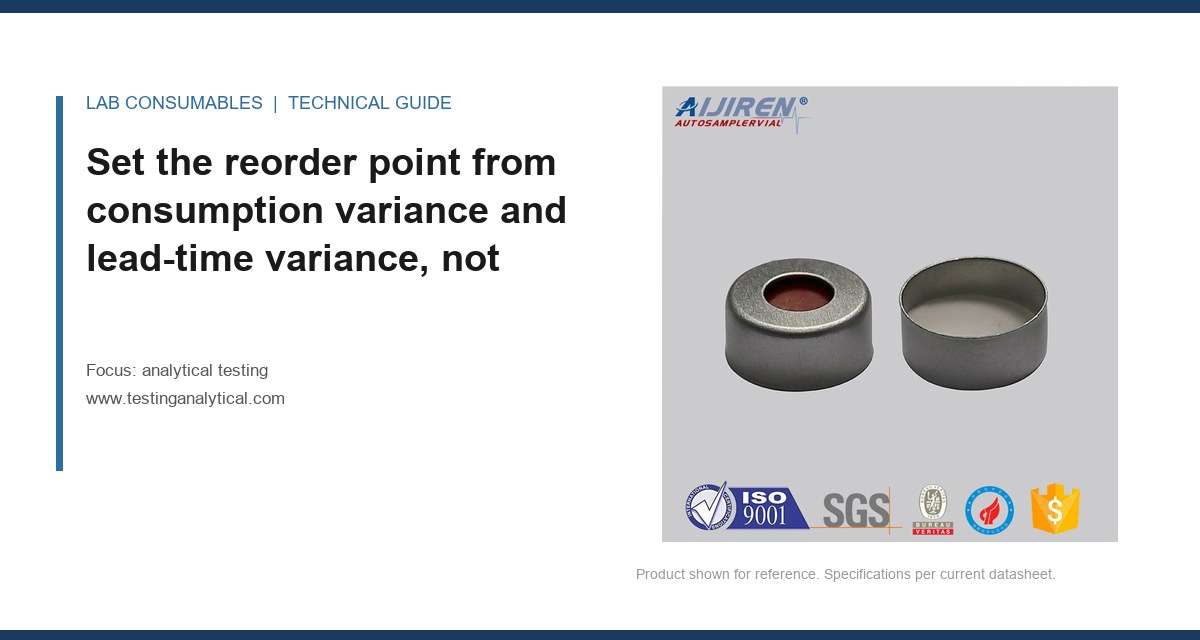
A 40 mL amber vial with a PTFE-faced silicone septum, 24 mm crimp, was the only consumable on the bench that ran out on a Tuesday morning in the middle of a 96-injection sequence. The lab had 312 of them on the shelf the previous Friday. Consumption that week was 14 per day, not the 6 per day the reorder point had been set against two years earlier. Nobody had recalculated the number. The sequence aborted at injection 61, the autosampler flagged a missing vial, and the analyst spent the next six hours re-running the batch. That is not a supply problem. It is a planning problem, and it is the one this article is about: analytical testing MOQ lead time and reorder point planning, done with numbers instead of habit.
Most labs I walk into can tell me their unit price per vial to four decimal places and cannot tell me their lead-time standard deviation. That asymmetry is where stockouts come from. The supplier’s MOQ and the courier’s transit variance are the two variables that decide whether your shelf is a buffer or a liability, and neither one is on the quote in a form most buyers read correctly.
Set the reorder point from consumption variance and lead-time variance, not from a gut feel
The reorder point is the inventory level that triggers a purchase order. The formula most procurement teams use is consumption rate times lead time, plus a safety stock they picked because it felt right. That formula is wrong in one specific way: it treats lead time as a constant. It is not. A 24 mm crimp cap that ships in 5 days from a domestic distributor can take 19 days when the anodized aluminum shell is on allocation, and the difference is not visible until you are already out.
The version that works uses both variances:
ROP = (d × L) + Z × √(L × σd² + d² × σL²)
Where d is mean daily consumption, L is mean lead time in days, σd is the standard deviation of daily consumption, σL is the standard deviation of lead time, and Z is the service-level factor (1.65 for 95%, 2.33 for 99%). For a 9 mm screw-thread autosampler vial on a routine HPLC method, a working example looks like this:
- Mean daily consumption d = 22 vials/day across three instruments
- Mean lead time L = 11 days (order to dock, not order to ship)
- Consumption standard deviation σd = 6 vials/day (batch days run hot)
- Lead-time standard deviation σL = 4.5 days (one supplier, one courier, no backup)
- Service level 95%, so Z = 1.65
Plug it in: (22 × 11) + 1.65 × √(11 × 36 + 484 × 20.25) = 242 + 1.65 × √(396 + 9801) = 242 + 1.65 × 101 = 409 vials. Compare that to the naive calculation of 242. The gap of 167 vials is the safety stock the naive formula silently omits, and it is exactly the quantity that was missing on that Tuesday.
Where the lead-time variance actually comes from
I have tracked this across four consumable categories and the pattern holds. For commodity items (borosilicate glass vials, PP caps, septa in standard durometer), the variance is dominated by the courier, and σL is typically 1.5 to 3 days. For anything with a molded or coated component, the variance comes from the supplier’s own scheduling, and σL is 4 to 9 days. For items tied to a specific instrument platform (a proprietary autosampler tray geometry, a specific septum thickness for a given needle penetration depth), σL can exceed 12 days because there is one qualified source and no substitute.
If you order from a single source with no second qualified supplier, you must use the σL from the worst 12 months, not the average. I have seen a lab set σL = 2 because “it usually ships next day” and then lose three weeks when the supplier’s molding line went down for a die repair. The 9 mm vials at vialforhplc.com are a good example of a category where you should always carry a second qualified source, because the dimensional stack (neck OD, thread pitch, septum thickness) has to match the autosampler or the needle will cor. That is a fit problem, not a supply problem, but it forces you to hold more safety stock than the formula alone would suggest.
What an MOQ does to carrying cost, in dollars per unit held
MOQ is the minimum order quantity the supplier will run. It exists because the supplier has to amortize a setup: a molding run, a coating batch, a sterilization cycle, a lot-release test. A 500-piece MOQ on a molded cap is not a sales tactic, it is the point at which the tooling and QC cost per unit drops below the price the supplier quoted.
The buyer’s problem is that MOQ pushes your average inventory up, and average inventory carries cost. The carrying cost rate for lab consumables in a controlled-storage environment is typically 18% to 28% per year of unit value, made up of:
- Storage space and environmental control (a 20 °C ± 5 °C, <60% RH room is not free)
- Insurance and shrinkage
- Capital tied up
- Obsolescence and expiry (septa degrade, coated surfaces lose performance, and a lot that sits 18 months past receipt is a write-off)
- Handling and cycle counting labor
Here is the arithmetic that decides whether an MOQ is a good deal. Suppose a 2 mL clear glass vial with a 9 mm screw thread costs $0.18 at MOQ 5,000 and $0.21 at MOQ 1,000. Your annual consumption is 8,000 units. At MOQ 1,000 you order 8 times a year, average inventory is 500 units, and carrying cost at 22% is 500 × $0.21 × 0.22 = $23.10/year. At MOQ 5,000 you order twice a year, average inventory is 2,500 units, and carrying cost is 2,500 × $0.18 × 0.22 = $99.00/year. The unit-price saving is $0.03 × 8,000 = $240/year. The carrying-cost penalty is $75.90/year. The MOQ is worth taking, but only by $164, not by $240.
Now change one number. If your annual consumption is 2,000 units, the MOQ 5,000 option means you hold 2.5 years of stock. Septa and coated surfaces will not survive that, and the carrying cost plus write-off exceeds the unit saving. The decision rule: take the MOQ only if annual consumption divided by MOQ is at least 2, meaning you turn the lot over twice a year. Below that, negotiate a smaller MOQ or split the order across two part numbers.
The MOQ trap specific to analytical consumables
Analytical consumables have a shelf-life dimension that general MRO stock does not. A PTFE-faced silicone septum has a usable life of roughly 3 years from manufacture if stored cool and dry; a pre-assembled crimp cap with a pre-inserted septum is shorter because the compression set starts the day it is assembled. A 5,000-piece MOQ on a pre-assembled cap you consume at 2,000/year means the last 1,000 pieces are 2 years old when they reach the autosampler. I have seen the failure mode: the septum has taken a set, the needle punctures it, and the seal does not re-close, so you get a 0.3 µL injection volume error that shows up as a 4% RSD on the internal standard. That is not a supplier defect. That is a planning decision that bought too much stock.
The fix is to ask for the lot date and the assembly date on every certificate of analysis, and to set a maximum stock age of 12 months for pre-assembled caps and 18 months for loose septa. If your MOQ forces you past that, the MOQ is wrong for you.
Lead time is not one number, and the one on the quote is the wrong one
When a supplier quotes “lead time 5 days,” they mean order to ship. The number you need for the reorder point is order to available on the shelf in your lab, which includes:
- Order processing and PO acknowledgment (0.5 to 2 days)
- Manufacturing or picking (0 to 15 days depending on whether the item is stocked or made to order)
- Lot release and CoA generation (1 to 3 days for regulated items)
- Transit (1 to 7 days domestic, 5 to 21 days international)
- Receiving, inspection, and put-away (0.5 to 1 day)
For a stocked item from a domestic distributor, the real number is typically 3 to 5 days. For a made-to-order item, it is 15 to 30. For an imported item with a customs hold, it can be 45. I have seen a lab set a reorder point against a 5-day lead time for an item that was actually made to order in a 20-day cycle, and they were out of stock every quarter like clockwork. The quote said 5 days because the supplier was quoting the transit time, not the manufacturing time.
The practical move is to measure it. For every consumable you order more than four times a year, log the PO date and the date the item was physically available in the stockroom. After six orders you have a real mean and a real standard deviation, and the formula above becomes usable. Until then, use the supplier’s manufacturing lead time plus 2 days for processing plus the transit time from the carrier’s published service standard, and add 50% to the total as a placeholder for σL.
Lead time for the items that matter most
The items with the longest lead time are usually the ones with the tightest specification. A standard 2 mL vial is stocked everywhere. A vial with a specific silanization treatment, a specific crimp dimension, or a certificate of conformity to a particular EPA SW-846 method requirement may be made to order. The same is true for GC septa with a specific bleed specification and for HPLC columns with a particular lot of stationary phase. If you are running methods under SW-846 or a validated USP procedure, the consumable is part of the method, and you cannot substitute a different lot or a different part number without re-verifying. That means the lead time for the qualified part is the lead time you must plan against, and the second-source option is not free.
This is where a lot-to-lot qualification program pays for itself. If you have qualified two suppliers for the same part number with the same dimensional spec, you can use the shorter of the two lead times in your reorder point and hold less safety stock. If you have qualified only one, your σL is whatever that one supplier’s worst quarter was. The chromatography consumables category is a good place to start building second sources, because the dimensional specs are published and the qualification test is a system suitability run, not a full method validation.
A decision table for setting the reorder point by item class
Not every consumable deserves the same planning rigor. I use four classes, and the class determines the method and the review cadence.
| Class | Example | Typical MOQ | Real lead time (days) | σL (days) | Reorder method | Review cadence |
|---|---|---|---|---|---|---|
| A: critical, single source | Qualified HPLC column lot, method-specific vial | 1 to 5 | 14 to 30 | 6 to 12 | Formula with Z = 2.33, hold 1 spare lot | Monthly |
| B: critical, dual source | 9 mm screw vial, standard septum | 1,000 to 5,000 | 5 to 12 | 2 to 4 | Formula with Z = 1.65 | Quarterly |
| C: commodity, high volume | PP caps, generic glass vials | 5,000 to 20,000 | 3 to 7 | 1 to 2 | Two-bin kanban, fixed quantity | Semi-annual |
| D: low volume, long shelf life | Specialty standards, rare adapters | 1 to 10 | 21 to 60 | 10 to 20 | Reorder on first use of last unit | Annual |
The Class A items are where the formula matters most and where most labs do the least. A qualified column lot that takes 21 days to arrive and has a 9-day σL needs a reorder point that includes roughly three weeks of safety stock, not three days. If you run that column on a method that reports to a client under a regulatory deadline, the cost of a stockout is not the price of the column, it is the re-run and the missed report date.
Two field cases where the planning number was the failure
Case 1: the 4% RSD that was a stock rotation problem
Symptom: a stability study on a small-molecule API started showing internal standard RSD of 3.8% to 4.2% on the 12th and 13th injections of each 96-well sequence, then recovering. The method had historically run at 1.1% RSD.
Measurement: the analyst pulled the septum from the failing wells and measured compression set. The septa had been in stock 26 months. The PTFE facing was intact but the silicone body had taken a permanent set, and the needle puncture did not re-seal, so the headspace in the vial equilibrated with the autosampler environment over the 40-minute run, changing the effective injection volume on later wells.
Fix: the lab had been ordering the pre-assembled caps at MOQ 10,000 against annual consumption of 4,000, so the last 2,000 pieces were always 18 to 24 months old. They cut the order to MOQ 4,000, added a first-in-first-out rotation with a 12-month maximum age on pre-assembled caps, and the RSD returned to 1.2%. The reorder point was recalculated with the new MOQ, and the carrying cost dropped by $340/year even though the unit price rose by $0.01.
Case 2: the reorder point that was set against the wrong lead time
Symptom: a lab running trace metals by ICP-MS ran out of a specific 15 mL centrifuge tube with a certified low metal background every quarter, always in the third week of the quarter.
Measurement: the buyer had set the reorder point at 200 units against a quoted lead time of 7 days and a consumption rate of 25/day. That gives a reorder point of 175 plus safety stock, so 200 looked fine. But the actual order-to-dock time was 22 days, because the tube was made to order in a 15-day cycle plus 5 days transit plus 2 days receiving. The 7-day quote was the transit time only.
Fix: the reorder point was recalculated at 25 × 22 + 1.65 × √(22 × 16 + 625 × 9) = 550 + 1.65 × √(352 + 5625) = 550 + 1.65 × 77 = 677 units. They also added a second qualified source with a 9-day lead time, which dropped σL from 3 to 1.5 and the reorder point to about 590. The quarterly stockout stopped. The carrying cost increase was $180/year. The cost of the previous stockouts, in re-runs and delayed reports, was roughly $2,400/year.
Set the review cadence from the consumption drift, not the calendar
The reorder point is a number that decays. Consumption changes when a method is added, when an instrument is retired, when a client’s sample volume shifts. A reorder point set 18 months ago is a guess about today’s consumption. The review cadence should match how fast consumption actually moves, and for most labs that is quarterly for Class A and B items and semi-annually for Class C.
The trigger for an out-of-cycle review is a consumption deviation of more than 20% from the trailing 90-day mean. If you track nothing else, track that. A 20% drift is enough to move a reorder point by a full week of cover, and a week of cover is the difference between a smooth quarter and a re-run.
One more operational point: the reorder point should be set against available stock, not on-hand stock. If 300 vials are on the shelf but 200 are allocated to a study that starts next week, your available stock is 100, and the reorder point of 409 is already breached. The system that holds your reorder points has to net out allocations, or the number is fiction. For labs running multiple studies against a shared stockroom, this is the single most common reason the formula “doesn’t work” when they try it.
If you are building this out for the first time, start with the five consumables that have caused the most re-runs in the last 12 months. Measure the real lead time for those five. Set the reorder point with the formula and a 95% service level. Review quarterly. That is enough to stop the Tuesday-morning stockouts, and it takes about four hours of setup. The rest of the catalog can follow. The full catalog of analytical testing consumables and the planning categories they fall into is at testinganalytical.com, and the lab vials range is a reasonable place to start the measurement because the consumption is high and the shelf life is finite.
For reference data on column and consumable specifications that feed the qualification step, the technical libraries at Agilent, Thermo Fisher, and Restek are the ones I use most, because they publish the dimensional and performance numbers you need to write a second-source qualification test.
The decision rule is this: set the reorder point from the measured order-to-dock lead time and its standard deviation, not the quoted transit time, and take an MOQ only when annual consumption is at least twice the MOQ. If either condition fails, the number you are planning against is not a reorder point, it is a guess with a decimal point.
References & further reading
Related resources from our lab consumables network:
- Analytical Testing at testinganalytical.com
- Hplc Vial at vialforhplc.com
- Chromatography Consumables at chromatographyconsumables.com
- Lab Vials at labvials.com
External references and standards: