
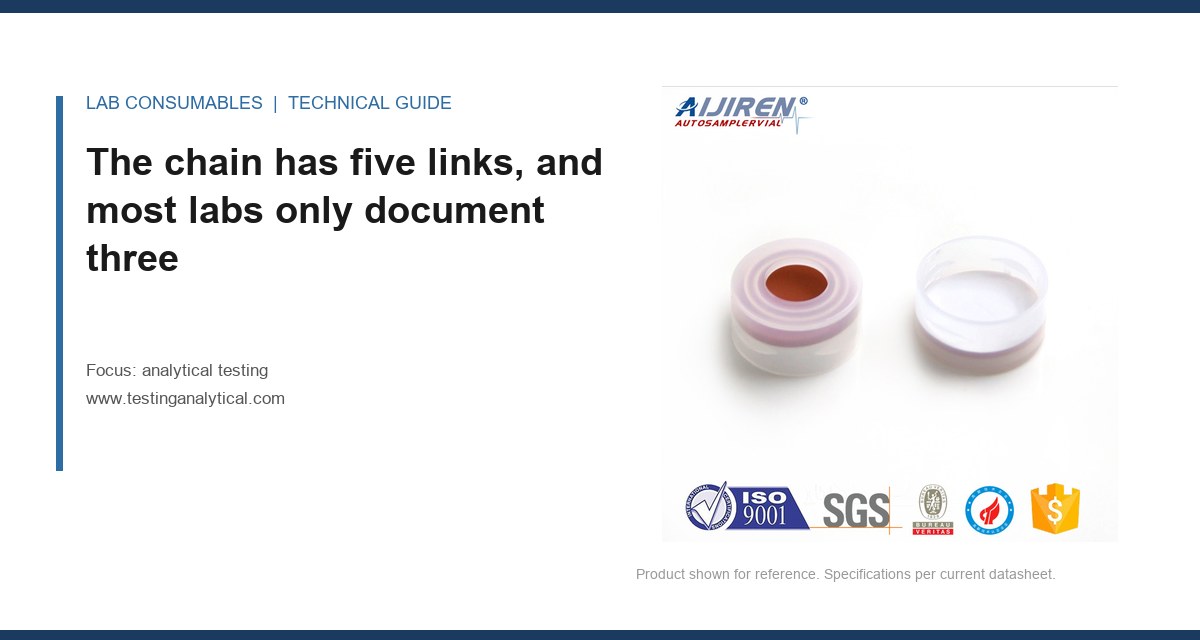
A 200 µL autosampler vial from lot 22-1147 gave a certified concentration of 10.02 mg/L on the CoA and 9.61 mg/L by our own ICP-MS check, a 4.1% low bias that repeated across six vials from the same case. The standard came from a vendor with a NIST-traceable certificate. The balance was calibrated that morning. The pipette had a current calibration certificate. Everything in the chain looked documented, and yet the number was wrong. What the paperwork could not show was the polypropylene of the vial, which carried a residual metal catalyst from a molding run that had switched resin suppliers eleven weeks earlier. That is the part of ISO 17025 traceability most labs get wrong: they trace the reference material and stop, and the container the material sits in never enters the chain at all.
Traceability under ISO/IEC 17025:2017 clause 6.5 is not a certificate. It is an unbroken sequence of comparisons, each with a stated uncertainty, that connects a reported result back to a defined reference. For a consumable used in an analytical method, that sequence has five links. I have audited enough labs to know which ones get skipped.
- Link 1, the reference material. The certified reference material or standard, with its certificate, expiry, and stated uncertainty. Almost every lab documents this one.
- Link 2, the preparation. The gravimetric or volumetric steps that turn the reference into a working standard, with balance calibration and pipette calibration traceable to a national metrology institute. Most labs document this too, though the pipette certificates often lag by months.
- Link 3, the container. The vial, the cap, the septum, the liner, the syringe, the filter. This is where the chain usually goes dark. The consumable contacts the standard and can change its concentration by adsorption, leaching, or permeation, and almost no lab can produce a traceable statement about what the consumable contributed.
- Link 4, the instrument. The detector response, calibrated against a traceable standard, with the calibration curve and its residuals. This is documented, sometimes over-documented.
- Link 5, the data reduction. The integration, the dilution factors, the unit conversions, all tied back to the raw signal. Documented in most accredited labs.
Links 1, 2, 4, and 5 are the ones auditors ask about, because they are the ones that have certificates attached. Link 3 is the one that has no certificate, and it is the one that breaks. When a result is challenged, the lab can produce a NIST-traceable standard certificate, a balance calibration, and a pipette certificate, and still be unable to say what the vial did to the sample. That gap is the traceability failure this article is about.
Why the consumable link cannot be closed by a certificate of analysis
A CoA from a vial manufacturer is not a traceability document. It is a conformance statement. It tells you the lot met a dimensional specification and a material specification, and it may list a resin grade. It does not tell you the extractable profile of that specific lot, and it does not carry an uncertainty statement tied to a reference method. The distinction matters because clause 6.5 requires metrological traceability, which means a documented chain, not a supplier’s word.
The practical consequence is that the consumable link has to be closed by the lab itself, with its own measurements, or by a supplier that publishes extractable data you can trace to a method. I have watched labs try to close it with a CoA and fail an assessment, because the assessor asked a simple question: show me the evidence that the vial did not contribute to the result. A CoA does not answer that. A lot-specific extractables study, run against a defined method with a stated detection limit, does.
This is where the consumable supply chain and the metrology chain have to meet. If you are sourcing chromatography consumables on price and dimensional fit alone, you are leaving link 3 open. The HPLC vial you choose is not a passive container. It is a variable in the measurement, and traceability requires you to bound that variable.
What an unbroken chain looks like for a single vial
Here is what I mean by unbroken, written out for one 2 mL clear glass vial with a PTFE-lined silicone septum, the most common configuration in a pharmaceutical QC lab. Each line is something an assessor can ask to see.
| Chain element | What must be documented | Typical value or tolerance | Who usually cannot produce it |
|---|---|---|---|
| Reference standard | Certificate, expiry, uncertainty | e.g. 1000 mg/L, U = 0.5% (k=2) | Rarely missing |
| Balance and pipette | Calibration certificate, traceable to NMI | Balance to 0.1 mg, pipette to ±0.5% | Sometimes expired |
| Vial glass | Hydrolytic class, lot, USP <661> test | Type I borosilicate, <0.5 mL 0.01 M HCl leachable | Often missing lot-level data |
| Septum | Material grade, extractables, puncture count | Silicone 50 Shore A, PTFE 0.13 mm, 3 to 5 punctures | Frequently missing |
| Cap and seal | Crimp or screw torque, seal integrity | Screw cap 0.6 to 0.9 N·m; crimp 0.8 to 1.2 N·m | Almost always missing |
| Extractables | Lot-specific study, method, LOD | LOD 0.1 µg/mL, no analyte above LOD | The usual break point |
| Instrument calibration | Curve, residuals, tune check | r² ≥ 0.999, residuals <5% | Rarely missing |
The row that reads “almost always missing” is the one I want to dwell on. Crimp and screw torque is a traceability element because the seal it produces determines whether the sample composition changes between preparation and injection. A screw cap torqued to 1.4 N·m deforms the septum and can create a channel; a cap torqued to 0.4 N·m fails to compress the liner and lets solvent evaporate. Either way, the concentration in the vial at injection is not the concentration you prepared, and the chain from standard to result is broken by a torque value nobody recorded.
The septum is the part of the chain with a shelf life
A silicone septum with a PTFE face is not inert forever. The PTFE film is typically 0.13 mm thick, and every needle puncture creates a small permanent deformation. After three to five punctures on the same vial, the reseal can fail under autosampler pressure, and volatile analytes escape. I have seen a headspace method lose 8% of a 50 ppm methanol standard over a 24-hour run because the septa had been punctured four times during a sequence re-injection. The fix was a new vial and septum per injection, which doubled consumable cost and eliminated the bias. That is a traceability decision, not a cost decision. If you cannot state how many punctures your septum has taken, you cannot state the composition of the sample at the detector.
The link most labs cannot produce: lot-specific extractables data
Ask a lab to show lot-specific extractables data for the vials currently on the bench and watch what happens. The usual answer is a generic extractables study from the manufacturer, sometimes five years old, sometimes covering a different resin grade. That is not traceability for the lot in use. It is a promise about a product family.
The reason this link is hard is that extractables testing is expensive and slow, and most labs do not run it themselves. The workable path is to require it from the supplier as a condition of purchase, with three specifics: the method (for example a 24-hour reflux in the actual sample solvent, not water), the detection limit (typically 0.1 µg/mL by LC-MS or GC-MS), and the lot number the study applies to. If the supplier cannot tie the study to a lot, you are back to a promise. The Restek technical resources library is a useful reference for what a defensible extractables protocol looks like, and the major instrument vendors publish comparable guidance through their Agilent chromatography consumables and columns documentation and Thermo Fisher chromatography and sample handling pages. Use those as templates, not as substitutes for lot data.
Field case 1: the drifting internal standard
A contract lab running EPA method 8260 by purge-and-trap saw its internal standard response fall 12% across a 60-injection sequence, with the decline starting around injection 20. The instrument tune was clean, the trap was new, and the internal standard solution was fresh. The measurement that identified the cause was a simple one: they weighed ten vials from the lot before and after a 24-hour storage of the internal standard solution at 4 °C and found an average mass loss of 1.8 mg per vial, consistent with methanol permeating the septum. The septa in that lot were a different silicone grade than the previous lot, softer and more permeable. The fix was a switch to a PTFE-faced septum with a verified permeation rate and a re-qualification of the lot against a stored standard. The traceability lesson: the internal standard certificate was perfect, and the chain still broke at the septum.
Field case 2: the 4% low bias on a metal standard
This is the case from the opening. A trace metals lab preparing calibration standards in 15 mL polypropylene tubes saw a consistent 3 to 4% low bias on a multi-element standard, worst for boron and aluminum. The reference material and the balance were fine. The measurement that found it was a leach test: they soaked tubes from the suspect lot in 2% nitric acid for 24 hours and ran the leachate by ICP-MS, finding 0.8 µg/L of boron and 1.2 µg/L of aluminum in the blank, plus a resin catalyst residue that bound the analytes. The tubes had been molded from a regrind blend. The fix was a switch to virgin-resin tubes with a lot-specific leach certificate and a requirement that the supplier state the resin source. Again, the reference material was traceable and the container was not.
How to close the consumable link without running a full study on every lot
You do not need a full extractables study on every case. You need a documented, risk-based scheme that closes the link for the analytes and matrices that matter. Here is the scheme I use, and it has survived several assessments.
- Tier the consumables by contact risk. Anything that holds the calibration standard or the final extract is tier 1. Anything that holds a rinse or a waste is tier 3. Tier 1 gets lot-level documentation; tier 3 gets a CoA and nothing more.
- Require lot-specific leach data for tier 1. Method, solvent, time, temperature, LOD, and the lot number. If the supplier cannot provide it, run an in-house leach on the first case of each lot and record it as a receiving inspection.
- Set a torque and puncture spec and record it. Screw caps 0.6 to 0.9 N·m, crimp caps 0.8 to 1.2 N·m, one septum per injection for volatile methods, maximum three punctures for non-volatile. Put the number on the SOP.
- Verify the dimensional fit against the autosampler. A vial that sits 0.3 mm high in the tray can cause a partial needle insertion and a false low result. Check the lab vials you buy against the autosampler’s stated stack tolerance, and check the U.S. EPA SW-846 test methods for any method-specific container requirements before you assume a generic vial is acceptable.
- Keep a lot traceability log. Lot number, receiving date, leach result, first use, last use. This is what closes link 3 in an audit, and it is a single spreadsheet if you keep it disciplined.
A receiving checklist that an assessor can follow
When a case of vials arrives, the following checklist takes about 40 minutes and produces the evidence that closes the consumable link. I have used a version of this for years, and it is the difference between a traceable result and a hopeful one.
| Check | Acceptance criterion | Record |
|---|---|---|
| Lot number on case matches CoA | Exact match | Log entry, date, initials |
| Glass class | Type I borosilicate, USP <661> | CoA reference |
| Septum grade | PTFE-faced silicone, 0.13 mm PTFE, 50 Shore A | CoA reference |
| Leach test, tier 1 | No analyte above 0.1 µg/mL in the method solvent | Leachate result, method, date |
| Dimensional check | Height and diameter within autosampler tolerance | Calipers reading, sample size 10 |
| Torque check | 0.6 to 0.9 N·m for screw caps | Torque wrench reading, sample size 5 |
| Puncture spec | Stated on SOP, one per injection for volatiles | SOP reference |
Two of these rows are the ones that fail most often in practice: the leach test and the torque check. Labs skip the leach test because it takes a day, and they skip the torque check because nobody owns a torque wrench. Buy the wrench. It costs less than a re-run, and it produces a number an assessor can verify.
The decision rule for procurement and for the bench
If you take one thing from this, take the rule: a consumable is traceable only when you can state, for the specific lot in use, what it contributed to the result and how you know. That statement has to name the method, the detection limit, and the lot. A CoA is not that statement. A generic extractables study is not that statement. A lot-specific leach result, a recorded torque, and a puncture count are.
For procurement, that means writing lot-level traceability into the purchase specification for tier 1 consumables, and being willing to pay for it. The price difference between a vial with lot-specific leach data and one without is usually a few cents per unit. The cost of a failed assessment or a re-run sequence is orders of magnitude higher. For the bench, it means treating the septum, the cap, and the torque as measurement variables, not housekeeping. The analytical testing result is only as traceable as its weakest link, and in most labs that link is the container nobody thought to question. Close it, and the chain holds from the certificate to the reported number. Leave it open, and you have a folder full of certificates that cannot answer the one question that matters: what did the vial do to my sample?
References & further reading
Related resources from our lab consumables network:
- Analytical Testing at testinganalytical.com
- Hplc Vial at vialforhplc.com
- Chromatography Consumables at chromatographyconsumables.com
- Lab Vials at labvials.com
External references and standards: