
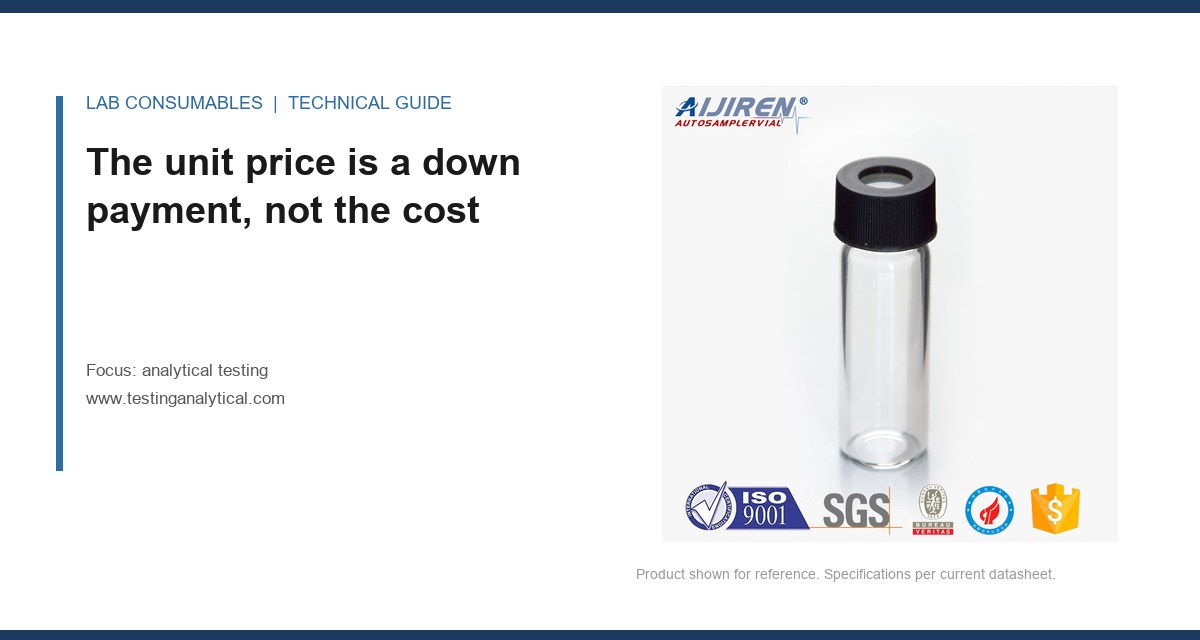
Last month I watched a procurement manager approve a 500-case order of 2 mL HPLC vials at $0.31 per unit, then bill the receiving lab $0.29 per unit in hidden costs on the same line item. The landed cost was $0.60, and that was before a single vial touched an autosampler. If you are doing analytical testing landed cost calculation with only the invoice price in front of you, you are pricing a different product than the one that shows up on the dock.
I have run distribution for chromatography consumables for long enough to know that the number on a purchase order is the smallest number in the transaction. The real number is what I call the cost per usable unit. That is the total spend divided by the number of units that actually produce valid data. When a lab buys 10,000 septa and 340 of them core during the first puncture, the cost per usable unit is not the invoice price divided by 10,000. It is the invoice price plus freight, duty, inspection labor, and replacement procurement divided by 9,660. That is the analytical testing landed cost calculation that matters.
Most procurement workflows treat landed cost as a logistics problem. It is not. It is a laboratory economics problem. A vial that arrives cracked is a logistics claim. A vial that arrives intact but fails under a 6 mm CTC PAL needle at 45 psi is a data problem, and it costs more. The distinction is where money hides.
Freight is the least interesting line item, until it is not
Freight cost per unit is easy to calculate and easy to get wrong. A 40-foot container of lab vials from a port in Ningbo to a warehouse in Memphis might run $4,800 to $6,200 depending on fuel and season. Spread across 1.2 million vials, that is $0.004 to $0.005 per unit. Nobody loses sleep over half a cent. But that math assumes the container arrives full, intact, and on time. It rarely does all three.
I have seen a pallet of 2 mL screw-top vials shifted in transit because the shipper used 3-ply corrugated instead of 5-ply. The outer cartons compressed, the inner trays cracked, and 11% of the vials had micro-fractures at the neck. The freight cost was still $0.004 per unit. The replacement air freight for 132,000 vials was $0.073 per unit. The inspection labor to sort good from bad was $0.018 per unit. Freight is only boring when nothing goes wrong.
The rule I give procurement teams is this: calculate freight at the expedited replacement rate, not the planned ocean rate. If your supplier cannot replace a failed lot by air inside 10 days without you paying a premium, the premium is your real freight cost. Ask the supplier for their air freight rate per kilogram before you sign the PO. If they will not quote it, the landed cost calculation is incomplete.
Duty and classification: the error that compounds every order
Analytical consumables are not one customs category. A glass vial with a PTFE-lined cap is not the same as a bare borosilicate tube. The Harmonized System code you use changes the duty rate, and the duty rate changes the landed cost by 3% to 9% depending on the country of origin and the material composition.
I once watched a distributor classify 9 mm screw-top autosampler vials under the general glassware heading at 3.2% duty. The correct classification for assembled vials with closures was 5.8%. The difference was $0.008 per unit. On a 2 million unit annual volume, that is $16,000 in unpaid duty that became a liability during an audit. The procurement manager who signed off on the lower classification saved $16,000 on paper and spent $41,000 on legal and penalty fees.
When I build an analytical testing landed cost calculation, I use the assembled article classification, not the component classification. A vial with a cap and septum is an assembled article. A bare vial is a glass container. A pre-slit PTFE/silicone septum is a polymer article. Get a binding ruling from customs before the first shipment, not after the third. The ruling costs $300 to $500 and takes 30 to 60 days. The penalty for misclassification is 20% of the underpaid duty plus interest. The ruling is cheaper.
Incoming inspection is a cost you will pay either way
You can pay for inspection at the dock or you can pay for it at the bench. The bench is more expensive by a factor of 4 to 10. When a lab receives 50,000 HPLC vials and puts them directly into inventory, the first person to notice a dimensional problem is the analyst running a sequence at 2 a.m. The autosampler jams. The sequence aborts. The analyst spends 45 minutes clearing the jam, replacing the vial, and re-queuing the run. That 45 minutes costs $65 to $120 in fully loaded analyst time. Times 50 jams per lot, that is $3,250 to $6,000 in bench labor that never appears on a purchase order.
Dock inspection costs less. A proper incoming inspection for vials and caps takes 2 to 3 hours per lot and checks these parameters:
- Neck diameter measured with a go/no-go gauge at 3 points per tray, tolerance ±0.05 mm
- Cap torque retention tested on 20 units at 8 to 10 in-lbs, no back-off after 24 hours
- Septum puncture count tested on 10 units with a 26-gauge needle, minimum 3 clean punctures with no coring
- Visual defect rate on a 200-unit random sample, accept on zero critical defects
That inspection costs $150 to $250 in labor and equipment time. It catches the lot that would have cost $3,000 at the bench. Inspection is not overhead. It is the cheapest line item in the landed cost calculation.
Storage cost is not the warehouse rent
Warehouse rent is a fixed cost. Storage cost for analytical consumables is a variable cost driven by shelf life, temperature sensitivity, and lot integrity. A PTFE/silicone septum has a finite life. The silicone layer leaches oligomers over time. The PTFE layer can delaminate if stored above 30°C or below 5°C. I have seen a pallet of septa stored in a non-climate-controlled warehouse in Houston for 18 months. The septa looked fine. The silicone had hardened by 22 Shore A points. The first analyst to use them got 14% RSD on a caffeine standard that should have run at 1.2% RSD. The septa were not leaking. They were not sealing. The silicone had lost its compression set recovery.
Storage cost per unit is the cost of the inventory that expires or degrades before use, divided by the units that survive. If you buy 100,000 septa and store them wrong for a year, and 30,000 of them produce out-of-spec results, the storage cost is not the $0.002 per unit per month of warehouse space. It is the $0.11 per unit you paid for the 30,000 septa that are now scrap, plus the $4,000 in analyst time spent troubleshooting the RSD problem.
My storage rule: septa and pre-slit caps get 12 months from date of manufacture, stored at 15 to 25°C, humidity below 60%. Bare glass vials get 36 months. Anything beyond that is a calculated risk, and the calculation belongs in the landed cost, not in the hope that it will be fine.
Failure cost is the bucket that eats the budget
Failure cost is where analytical testing landed cost calculation separates professionals from order-takers. A failed consumable does not just cost its own replacement. It costs the sample, the run, the analyst time, the instrument time, and sometimes the re-validation of the method.
Here is a worked example from a real contract lab. The lab bought 20,000 2 mL screw-top vials with pre-slit PTFE/silicone septa at $0.34 per unit. The lot had a 2.1% failure rate: 420 vials either cracked at the neck during capping or cored on the first puncture. The direct replacement cost for 420 vials was $142.80. That is the number a naive procurement team would report. The real cost was this:
- Replacement vials: $142.80
- Sample loss: 420 samples at $18.50 per sample preparation cost = $7,770
- Analyst time: 420 failures at 6 minutes each = 42 hours at $85/hour = $3,570
- Instrument downtime: 3.5 hours at $180/hour = $630
- Re-run consumables: mobile phase, standards, and waste disposal = $410
- Total failure cost: $12,522.80
The cost per usable unit is not $0.34. It is ($0.34 × 20,000 + $12,522.80) ÷ 19,580 = $0.98 per usable vial. That is a 188% increase over the invoice price. The procurement manager who negotiated the $0.34 price saved the company $0.02 per unit versus the previous supplier at $0.36. The failure cost ate the savings 94 times over.
This is why I tell labs to stop negotiating on unit price and start negotiating on failure rate guarantees. A supplier who will not put a maximum defect rate in writing is telling you what their failure cost will be. A supplier who will commit to a 0.5% maximum defect rate with a credit for overage is pricing their own quality control into the transaction. That is a supplier who understands landed cost.
The worked calculation: from invoice to cost per usable unit
Let me walk through the full analytical testing landed cost calculation for a realistic purchase, so you have a template. The product is 50,000 2 mL 9 mm screw-top HPLC vials with pre-slit PTFE/silicone septa, shipped from a supplier in Germany to a lab in New Jersey.
| Cost bucket | Calculation | Cost per unit |
|---|---|---|
| Invoice price | $0.32 × 50,000 | $0.3200 |
| Freight (air, 3 pallets, 680 kg) | $4,760 ÷ 50,000 | $0.0952 |
| Duty (assembled article, 5.8%) | $0.32 × 0.058 | $0.0186 |
| Customs broker fee | $185 ÷ 50,000 | $0.0037 |
| Incoming inspection | $260 ÷ 50,000 | $0.0052 |
| Storage (3 months, climate-controlled) | $0.004 × 3 | $0.0120 |
| Expected failure rate (0.8%) | 400 units × $38.50 failure cost ÷ 49,600 usable | $0.3105 |
| Total landed cost per usable unit | $0.7652 |
The invoice price was $0.32. The cost per usable unit is $0.77. The difference is $0.45 per unit, and $0.31 of that is failure cost. If the lab had selected a supplier with a 0.2% failure rate at $0.36 per unit, the landed cost would be $0.71 per usable unit. The cheaper invoice price was the more expensive product.
This is the calculation that belongs in every purchase decision for chromatography consumables. It is not complicated. It is just honest.
Two field cases where landed cost changed the purchase decision
Case one: a pharmaceutical QC lab in the Midwest was buying 1.5 mL snap-top vials from a domestic supplier at $0.41 per unit. The vials had a chronic problem: the snap ring would not seat consistently on the autosampler tray. The lab was losing 3 to 4 runs per week to vial seating failures. The procurement team ran the landed cost calculation and found the failure rate was 1.7%, and the failure cost per incident was $41. The landed cost per usable vial was $0.89. They switched to a supplier at $0.47 per unit with a 0.3% failure rate. The landed cost dropped to $0.63. The unit price went up $0.06. The cost per usable unit dropped $0.26.
Case two: an environmental lab running EPA SW-846 methods was buying 40 mL VOA vials with open-top caps and PTFE-faced silicone septa. They sourced from a low-cost supplier in Southeast Asia at $0.28 per unit. The vials arrived with a 4.2% defect rate: cracked threads, septa that would not seal under the 40 mL VOA cap torque of 12 in-lbs, and visible glass particulates. The lab spent $6,400 on incoming inspection, rejected 2,100 vials, and had to re-order from a second source at $0.39 per unit with air freight at $0.11 per unit. The landed cost per usable vial from the cheap supplier was $0.71. The landed cost from the second source was $0.54. The cheap supplier was 31% more expensive when the calculation included the failure cost.
The pattern is the same in both cases. The procurement team that looked only at unit price made the wrong decision. The team that ran the analytical testing landed cost calculation made the right one.
What to ask a supplier before you calculate anything
Most suppliers will not volunteer the data you need for a proper landed cost calculation. You have to ask. These are the questions I put in front of every supplier before a first purchase:
- What is your maximum defect rate per lot, and how do you measure it? If the answer is “we do 100% inspection,” that is a red flag. Nobody does 100% inspection on 50,000 vials. The answer should be a statistical sampling plan with an AQL, not a slogan.
- What is your air freight rate per kilogram for replacement lots? If they cannot quote it, they have never had to replace a lot, or they do not plan to.
- What is the shelf life of the septum from date of manufacture, and what are the storage conditions? If the answer is “indefinite” or “room temperature,” ask for the stability data. PTFE/silicone septa do not last indefinitely.
- Can you provide a certificate of analysis for each lot that includes puncture count, compression set, and dimensional tolerances? If the answer is no, the incoming inspection cost goes up because you have to do all of that testing yourself.
- What is your credit policy for lots that exceed the agreed defect rate? A supplier who offers a credit for the defective units only is not covering your failure cost. A supplier who offers a credit for the full landed cost of the failed units is pricing their own risk.
These questions are not adversarial. They are the minimum information required to run a real landed cost calculation. A supplier who cannot answer them is a supplier who has not thought about your cost structure. That is a supplier who will cost you more than their invoice suggests.
The decision rule that replaces the unit price comparison
Stop comparing unit prices. Start comparing cost per usable unit at a defined failure rate. The calculation is simple:
Cost per usable unit = (invoice price + freight + duty + inspection + storage + failure cost) ÷ (units purchased × (1 − defect rate))
The failure cost is the number you have to estimate honestly. If you do not have historical failure data for a supplier, use 2% as a starting assumption for a new supplier and adjust after the first three lots. If the supplier will not commit to a defect rate in writing, use 4%. That is not pessimistic. It is the average failure rate I have seen from unproven suppliers across 15 years of distribution.
When you run this calculation, the purchase decision often flips. The $0.31 vial becomes $0.77. The $0.47 vial becomes $0.63. The procurement team that runs the calculation makes a different choice than the one that reads the price list.
The lab manager who approved that 500-case order at $0.31 per unit did not make a $0.31 decision. They made a $0.60 decision and did not know it. The analytical testing landed cost calculation is the only tool that shows the real number. If you are not running it, you are not buying analytical consumables. You are buying surprises.
For the full range of analytical testing consumables and the data to run this calculation on every lot, check the specifications from Agilent, Thermo Fisher, and Restek before you sign the next PO. The data is there. The calculation is yours to run.
References & further reading
Related resources from our lab consumables network:
- Analytical Testing at testinganalytical.com
- Hplc Vial at vialforhplc.com
- Chromatography Consumables at chromatographyconsumables.com
- Lab Vials at labvials.com
External references and standards: