
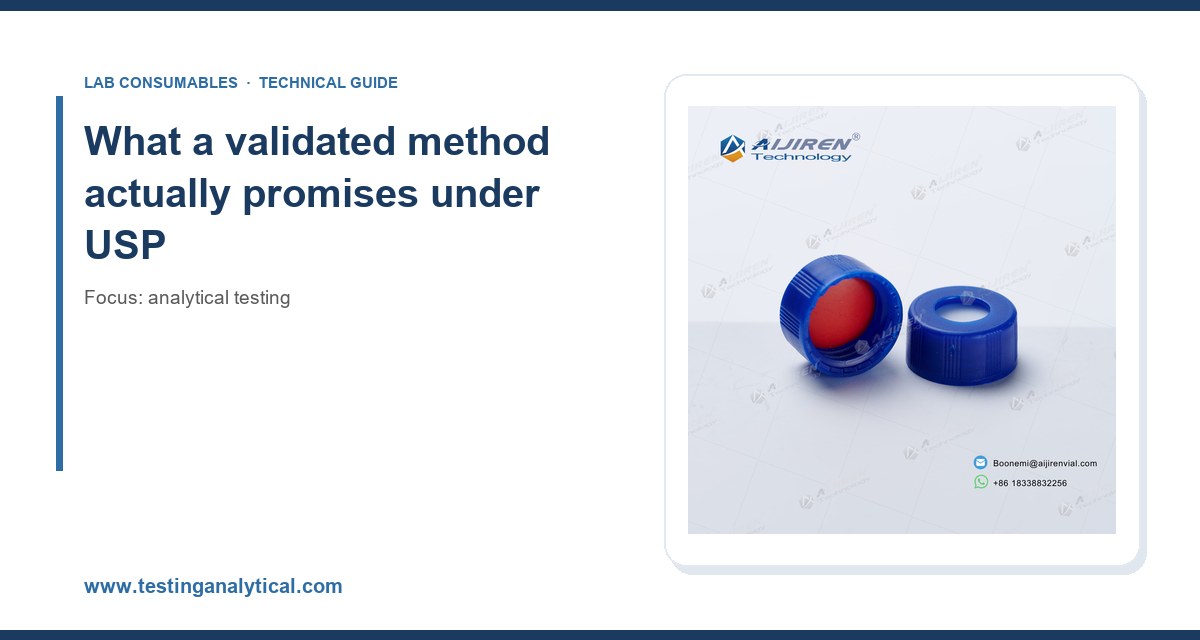
I once watched a validated HPLC method fail its first USP <621> system suitability check on a Monday morning because the previous analyst had switched to a different lot of HPLC vials with a slightly thinner septum. The method was fine. The validation package was fine. The chromatogram was not: tailing factor drifted to 2.3 against a 2.0 limit, and the run was rejected. That morning taught me something I now repeat to every lab I audit: a validated method is not a document, it is a contract with USP that you must re-earn every single run.
Most labs treat USP compliance as a chapter-by-chapter reading exercise. Read <621>, read <1225>, tick the boxes, file the validation report. That approach misses the point. USP requirements are not a checklist you clear once. They are a set of operating constraints that have to hold on every injection, every standard preparation, every column lot change, and every analyst shift. This article is about how those constraints actually bind a validated method in routine operation, and where the seams open up.
USP General Chapter <1225> defines validation as the process of demonstrating that an analytical procedure is suitable for its intended purpose. That is the promise. The validation report you write is the evidence. But USP does not stop there. Chapters <621> (chromatography), <711> (dissolution), <905> (uniformity of dosage units), and the general <1010> (analytical data) all impose ongoing requirements that sit on top of validation. A method can be perfectly validated and still be out of compliance on a Tuesday because the system suitability criteria were met with a fresh column but not with the column you are actually running.
The practical consequence is that validation is the floor, not the ceiling. USP expects you to demonstrate suitability at the time of analysis, not just at the time of validation. That distinction is where most compliance failures originate. If your SOP says “system suitability was established during validation,” you have a finding waiting to happen.
The three USP layers that touch a validated method
I find it useful to separate USP requirements into three layers, because each one fails differently:
- Method-level requirements (<1225>, <1226>): what the validation package must contain, and how verification of compendial methods works when you adopt a USP method without revalidating it.
- System-level requirements (<621>): what the chromatographic system must demonstrate on the day of analysis, including resolution, tailing, theoretical plates, and RSD.
- Data-level requirements (<1010>): how the raw data, integration, and audit trail must be handled so the result is defensible.
Every compliance failure I have investigated in twenty years fits into one of those three buckets. The pattern is almost always the same: the method-level work was done carefully, and the system-level or data-level work was treated as routine and drifted.
USP <621> system suitability: the numbers that actually bind you
System suitability is the operational heart of USP compliance for chromatographic methods. <621> does not prescribe fixed acceptance criteria for every method; it tells you to establish them, then verify them on the day. But the chapter does give concrete anchors that most methods adopt directly. If you are running a typical reversed-phase HPLC assay, the numbers you are defending look like this:
- Resolution (Rs): not less than 2.0 between the analyte and the nearest significant peak. For stability-indicating methods, I push for 2.5 because degradation peaks can migrate into the gap over the shelf life.
- Tailing factor (T): not more than 2.0. For basic analytes on older C18 columns, I have seen this fail at 2.4 within 200 injections of a new column.
- Theoretical plates (N): method-specific, but typically not less than 2000 for a 150 mm × 4.6 mm, 5 µm column, and often not less than 5000 for a 250 mm column.
- %RSD of replicate injections: not more than 2.0% for five injections at the assay level. For impurity methods at the 0.1% level, 5.0% or even 10.0% is common and defensible.
- Capacity factor (k’): typically not less than 2.0 to keep the analyte clear of the solvent front.
Those numbers are not arbitrary. They reflect the minimum separation and precision needed for the result to mean anything. When a lab tells me their method “passed validation but fails system suitability in routine use,” the first thing I ask is which criterion is failing. Nine times out of ten it is tailing factor or resolution, and nine times out of ten the cause is a consumable change, not an instrument fault.
Where <621> compliance quietly breaks
The most common failure mode I see is not a single bad injection. It is a slow drift that nobody catches because the system suitability standard is prepared once and injected once at the start of the run. By injection 80, the column has lost 15% of its plate count and the tailing factor has crept from 1.4 to 1.9. The run still “passes” because the suitability check was at the front. USP <621> allows bracketing suitability checks, and I recommend them for any run longer than about 40 injections. A mid-run suitability injection and an end-of-run suitability injection cost you ten minutes and save you a re-run.
The second failure mode is the standard preparation itself. If your working standard is prepared in a volumetric flask that was rinsed with tap water and dried in a 105 °C oven, you are introducing a variable that USP cannot help you with. I have traced a 3% low bias in an assay to residual detergent on glassware that had been washed in a new dishwasher cycle. The method was validated. The glassware was not.
Verification vs. revalidation: the decision most labs get wrong
USP <1226> covers verification of compendial methods. The rule is straightforward in principle: if you use a USP method as written, you verify that it works in your hands under your conditions. You do not revalidate it. If you modify the method, you revalidate the modified portion. The trouble is that “as written” is a moving target, because USP methods are written with allowable adjustments in the chapter text, and analysts routinely make adjustments that they believe are within the allowance when they are not.
Here is the decision checklist I use when a lab asks whether a change requires verification or revalidation:
- pH of mobile phase: ±0.2 units is the usual allowance. A change from 3.0 to 3.5 is a revalidation trigger, not a verification.
- Buffer concentration: ±10% is common. A change from 20 mM to 25 mM is a 25% increase and requires revalidation.
- Organic modifier percentage: ±2% absolute for isocratic methods. A change from 40% acetonitrile to 45% is outside the allowance.
- Column dimensions: length ±70%, internal diameter ±25%, particle size ±50% (with adjustment of flow rate to keep linear velocity constant). A swap from 150 × 4.6 mm, 5 µm to 100 × 2.1 mm, 1.8 µm is a method transfer, not a verification.
- Flow rate: ±50% for isocratic, ±30% for gradient. A change from 1.0 to 1.5 mL/min is at the edge and should be documented with a suitability check.
- Injection volume: can be reduced, not increased, without revalidation, provided the detection limit is still met.
- Column temperature: ±10 °C is the typical allowance, but for methods where selectivity is temperature-sensitive (many ion-pair and chiral methods), I treat ±5 °C as the practical limit.
The trap is that a “verification” run that fails system suitability is not a verification. It is evidence that the method does not work in your hands, and USP expects you to investigate before you release any data. I have seen labs file a failed verification as a “minor deviation” and release the batch anyway. That is the kind of finding that ends in a 483.
Columns, vials, and the consumable side of USP compliance
Here is the part of USP compliance that gets the least attention in training and the most attention in audits: the consumables. A validated method assumes a specific column chemistry, a specific particle size, and a specific sample introduction path. Change any of those and you have changed the method, whether or not you filed a change control.
Column selection and lot-to-lot reproducibility
USP does not name a column brand, but the method validation package does, implicitly, because the validation data were generated on a particular column. When you switch to a different lot of the same column, you are relying on the manufacturer’s reproducibility. For most modern C18 columns, lot-to-lot retention time reproducibility is within ±2%, which is usually fine. For older or less tightly controlled chemistries, I have seen ±8% shifts, which is enough to blow a resolution criterion. If your method has a resolution margin under 3.0, run a lot-to-lot comparison before you commit a new column to a stability study. The Agilent column and consumable documentation is a good place to check the manufacturer’s stated reproducibility for a given chemistry before you assume it.
For GC methods under USP <621>, the same logic applies to the inlet liner. A liner with a fresh deactivation layer gives you a different response for active analytes than a liner that has seen 200 injections. I replace liners every 100 to 150 injections for dirty matrices and every 300 injections for clean ones, and I document the change in the run log so the audit trail shows the maintenance was planned, not reactive.
Vials and septa: the small components that move the RSD
Sample introduction is where I see the most avoidable USP failures. A 2 mL lab vial with a 9 mm screw thread and a PTFE/silicone septum is standard for HPLC autosamplers, but the details matter more than most analysts realize. The septum thickness, the durometer of the silicone, and the number of times the needle has punctured the same spot all affect injection volume reproducibility. A septum that has been punctured 50 times in the same location will coring and produce a partial injection. I cap the puncture count at one injection per vial position for critical assays, and I use pre-slit septa for methods where the autosampler needle is a 22-gauge or larger.
For LC-MS methods, the vial matters even more. Glass vials can leach sodium and potassium at low levels, which suppresses ionization for some analytes. I use deactivated glass or polypropylene for any method with a lower limit of quantification below 1 ng/mL. The HPLC vial selection guide on our sister site covers the septum and glass options in more detail than I can fit here.
One concrete number worth memorizing: the standard 9 mm screw cap should be tightened to hand-tight, roughly 1.5 to 2.0 in-lb. Over-torquing deforms the septum and creates a path for evaporation. Under-torquing lets the vial loosen during the run. I have measured 3 to 5% loss of a volatile solvent from a loosely capped vial over a 24-hour autosampler run, which is enough to shift a retention time and fail a suitability check.
Mobile phase and water quality
USP <621> assumes your mobile phase is what you say it is. HPLC-grade water from a system that has not had its filters changed in 18 months is not HPLC-grade water. I check the resistivity (should be 18.2 MΩ·cm at 25 °C) and the total organic carbon (under 5 ppb) monthly and log it. For gradient methods, a dirty water supply shows up as a rising baseline and ghost peaks, which analysts then chase as “column problems” for a week before someone checks the water system.
The data integrity layer: <1010> and the audit trail
USP <1010> is short and easy to skim, and that is exactly why it gets ignored. It requires that analytical data be attributable, legible, contemporaneous, original, and accurate. In a validated method context, that means the integration parameters, the suitability calculations, and any manual reintegration must be traceable. If an analyst manually integrates a peak to bring the tailing factor under 2.0, that is a data integrity event, not a method adjustment. I have seen exactly this happen and get caught in an audit because the audit trail showed the reintegration but the run log did not mention it.
My rule is simple: any manual integration that changes a reported result by more than 0.5% gets a written justification in the run log, signed and dated. Any change to the integration algorithm or slope sensitivity gets the same treatment. The audit trail is not a formality; it is the evidence that the validated method was actually run as validated.
A troubleshooting checklist for USP compliance failures
When a validated method fails a USP requirement in routine operation, work through this in order. I have used this list for fifteen years and it catches about 90% of failures before they become deviations.
- Check the system suitability standard first. Was it prepared fresh? Was it stored correctly? A standard that has been on the autosampler for 48 hours is not the same standard you validated against.
- Check the column history. How many injections since the last column change? What was the last sample matrix? A column that has seen a high-protein matrix will not behave like a fresh column.
- Check the mobile phase age and preparation. Buffer that has been sitting for a week has a different pH than buffer prepared this morning. I cap mobile phase at 48 hours for aqueous buffers and 5 days for high-organic phases.
- Check the vial and septum. Is the septum pre-slit? Has it been punctured more than once? Is the cap torqued correctly?
- Check the water system. Resistivity and TOC, logged this month.
- Check the detector lamp hours. A deuterium lamp past 2000 hours will drift in intensity and produce a noisy baseline that looks like a column problem.
- Check the integration. Was the peak integrated the same way as in validation? Slope sensitivity, peak width, and baseline handling all change the reported numbers.
- Check the analyst. Not to blame, but to identify training gaps. A new analyst on a validated method is a verification event under <1226>.
Recommendation: build the compliance into the routine, not the review
If you take one thing from this article, take this: USP compliance for a validated method is a daily operational discipline, not an annual documentation exercise. The labs that pass audits cleanly are the ones where system suitability is checked at the start, middle, and end of every run; where consumables are tracked by lot and injection count; where mobile phase age is logged; and where any manual integration is justified in writing. The labs that get 483s are the ones where the validation report is beautiful and the routine operation is invisible.
Concretely, here is what I would put in place this quarter if I were running your lab:
- A system suitability log that records Rs, T, N, and %RSD at the start, middle, and end of every run over 40 injections.
- A consumable tracking sheet that records column lot, injection count, and suitability results at each lot change, with a hard stop at the manufacturer’s recommended injection limit or at 500 injections, whichever comes first.
- A septum and vial policy that caps puncture count at one per position for critical assays and specifies 9 mm screw thread, PTFE/silicone, pre-slit for autosamplers with 22-gauge needles.
- A mobile phase log with preparation date, pH, and a 48-hour expiry for aqueous buffers.
- A manual integration justification form that requires a signature for any change over 0.5% of the reported result.
- A quarterly review of the validation package against the current SOP to catch drift between what was validated and what is being run.
None of those items are expensive. All of them are auditable. And together they close the gap between the method you validated and the method you are actually running, which is the only gap USP cares about. If you are auditing your own lab against USP requirements this year, start with the consumables and the system suitability log. The rest of the compliance picture tends to hold up once those two are solid. For a broader view of how these pieces fit into a testing program, the resources at testinganalytical.com and the technical notes at chromatographyconsumables.com are worth bookmarking, and the manufacturer documentation from Thermo Fisher, Restek, and the EPA SW-846 methods will fill in the method-specific numbers that USP leaves to you to establish.
The takeaway is blunt: a validated method is a promise you keep on every injection. USP tells you what the promise is. Your consumables, your mobile phase, your integration, and your logbook are how you keep it. Get those four right and the audit takes care of itself.
References & further reading
Related resources from our lab consumables network:
- Analytical Testing at testinganalytical.com
- Hplc Vial at vialforhplc.com
- Chromatography Consumables at chromatographyconsumables.com
- Lab Vials at labvials.com
External references and standards: