
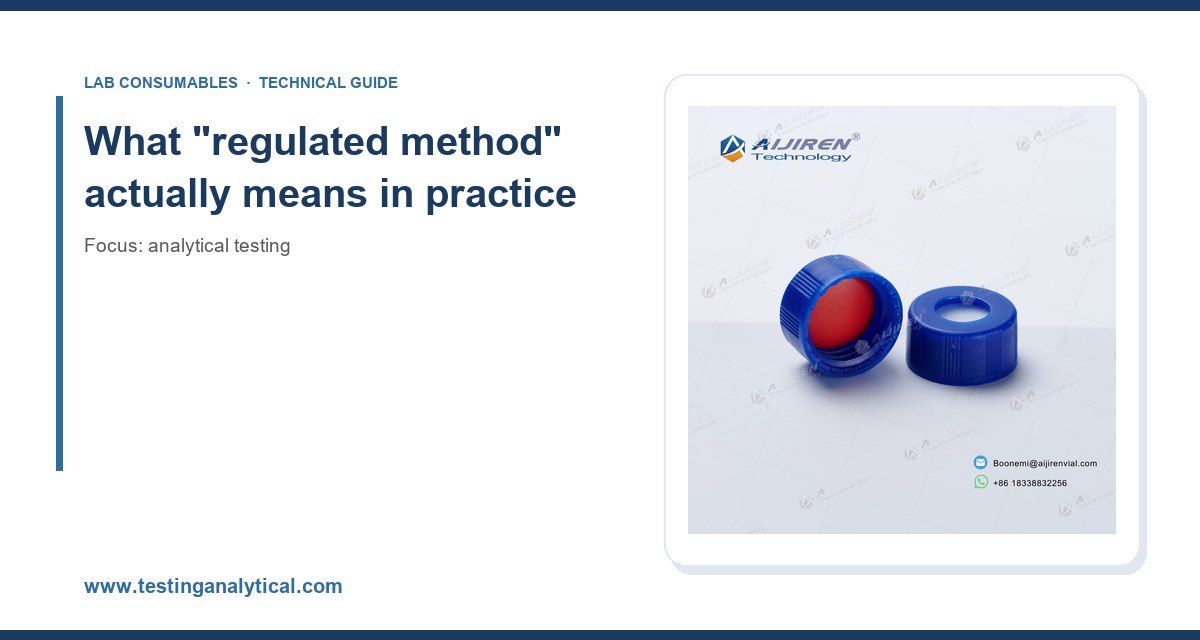
I once watched a method validation package get rejected over a septa specification. The lab had run EPA 8260 for volatile organics for eleven years with the same vial and cap combination, and a new procurement buyer swapped in a cheaper silicone septa to save four cents a unit. The method still passed calibration. It failed the continuing calibration verification on day three because the septa were bleeding siloxanes into the headspace and co-eluting with the internal standard. That is the reality of regulated analytical methods: the written procedure is only half the compliance story. The consumables, the hardware, and the traceable documentation around both carry the other half.
This article covers what actually matters when you run methods governed by EPA SW-846, ISO 17025, and AOAC Official Methods. I will get into the specific numbers, the failure modes I have dealt with on the bench, and the selection criteria that keep an audit clean.
A regulated method is not just a recipe. It is a contract between your laboratory and an authority that will inspect your records. Three frameworks dominate analytical testing in North America and Europe, and they differ in how prescriptive they are.
EPA SW-846: performance-based with mandatory quality control
SW-846 is the U.S. EPA’s test methods for evaluating solid waste. It covers everything from 8270 semivolatiles to 8082 PCBs. The key feature is that SW-846 methods are performance-based. You can modify a method provided you demonstrate equivalent performance through the quality control criteria in Chapter One. That flexibility is a trap for the unwary. If you change the column dimensions in 8270E from a 30 m x 0.25 mm x 0.25 µm to a 30 m x 0.32 mm x 1.0 µm to improve peak shape, you own the burden of proving the analyte list still resolves and the internal standard response holds within the method’s acceptance window (typically 60 to 125 percent for most analytes, tighter for calibration check compounds).
The other thing people miss: SW-846 references specific consumable performance implicitly through the QC criteria. Method blanks, method detection limits (MDL), and the initial and continuing calibration checks all act as canaries. A bleeding septa or a contaminated liner shows up as elevated baseline or failing internal standards before it shows up as a data quality problem on a report.
ISO 17025: the laboratory competence layer
ISO/IEC 17025 is not a method. It is the accreditation standard for testing and calibration laboratories. It governs how you document method selection, validation, equipment calibration, and traceability. When an ISO 17025 assessor walks in, they ask for the method validation report, the equipment maintenance log, and the records showing your reference standards are traceable. They will also ask how you control consumable quality. That is where a lot of labs get caught flat-footed. If you cannot show that your HPLC vials meet a documented specification (dimensional tolerance, glass grade, septa durometer), the assessor will write a finding.
AOAC Official Methods: prescriptive and collaborative-study backed
AOAC methods are used heavily in food, feed, and dietary supplement testing. Unlike SW-846, AOAC Official Methods of Analysis are typically prescriptive. The method specifies the column, the reagents, the sample prep, and the calculation. You can buy an AOAC method and it tells you exactly what to do. The tradeoff is less flexibility. If your instrument cannot accommodate the specified column length, you either buy a new instrument or you validate a modification and document it as a “method extension,” which is a heavier lift than an SW-846 equivalency demonstration.
Consumables are part of the method, whether the method says so or not
Here is my opinion after fifteen years of this: most method failures I have investigated were not chemistry failures. They were consumable failures that the method did not name explicitly. SW-846 does not tell you to use a specific septa. But the QC criteria in the method will absolutely fail if your septa are wrong. So the method effectively regulates the consumable through the back door.
The septa problem in headspace and volatile methods
Headspace GC methods (EPA 5021, 8260, and the ISO equivalents) are brutal on septa. You are heating the vial to 60 to 90 degrees C, puncturing the septa with a needle, and pressurizing the headspace. A typical 20 mm crimp cap septa with a PTFE-faced silicone construction is the baseline. The PTFE face protects the sample from the silicone and the silicone provides the reseal. Get the durometer wrong and you get coring, where the needle punches a plug of septa into the vial. I have seen coring produce a 15 percent low bias on early-eluting compounds because the plug absorbs analyte.
Puncture count matters more than people think. A good PTFE/silicone septa for headspace is rated for one puncture. It is single-use by design. If your autosampler is reusing vials (some labs do this to save money), you are gambling. For crimp-top HPLC vials, a PTFE/silicone septa is typically rated for 3 to 5 punctures before reseal integrity degrades. For screw-thread vials with a pre-slit septa, you can push to 10 punctures if the septa is a quality molded part, but I would not bet a regulated method on more than 5.
Glass: the specification nobody reads
Vial glass is not generic. USP Type I borosilicate is the standard for analytical work because it has low extractables. Type III soda-lime glass will leach sodium and calcium into aqueous samples, which shows up as elevated baseline in ion chromatography and as adduct formation in LC-MS. For regulated methods, insist on USP Type I, Class A or B borosilicate with a documented hydrolytic resistance. The dimensional tolerance matters too. A 12 x 32 mm vial with a 6 mm neck is the de facto standard for autosamplers, but the neck OD tolerance should be held to +/- 0.2 mm or you get autosampler gripper errors and needle misalignment.
For a deeper look at how these consumable choices roll up into an overall testing program, the team at analytical testing has published practical guidance that aligns with what I have seen on the bench.
Selection criteria with numbers
Here is the decision framework I use when specifying consumables for a regulated method. These are the parameters I put in a specification document that an ISO 17025 assessor can review.
Vial and cap specification
- Glass: USP Type I borosilicate, hydrolytic resistance per USP <661>. Document the glass lot.
- Dimensions: 12 x 32 mm for standard autosamplers; neck OD 6.0 mm +/- 0.2 mm.
- Septa: PTFE-faced silicone for headspace (single puncture); PTFE/silicone for HPLC (3 to 5 punctures); pre-slit for screw-thread autosamplers where needle coring is a risk.
- Septa durometer: 45 to 55 Shore A for good reseal without excessive needle drag.
- Crimp: 20 mm aluminum crimp, torque to 1.5 to 2.0 N·m with a calibrated crimper. Under-crimping leaks; over-crimping cracks the neck.
- Thread: 9 mm screw-thread (GPI 9 mm) is common for LC autosamplers; verify against your autosampler’s specified format.
Column and hardware specification
- Column dimensions: match the method. A 30 m x 0.25 mm x 0.25 µm GC column is the SW-846 default for many volatile and semivolatile methods. Do not change film thickness without re-validating resolution.
- Temperature rating: the column’s maximum temperature must exceed your method’s final oven temperature by at least 20 degrees C to avoid stationary phase bleed.
- Ferrules: graphite for GC (single-use, do not reuse); graphite/vespel for high-temperature applications. Torque to the manufacturer’s spec, typically 1/4 to 1/2 turn past finger-tight.
- Liners: deactivated glass wool for split/splitless injection; replace every 50 to 100 injections for dirty matrices, every 200 for clean ones.
For columns and accessories, the manufacturer technical resources are worth bookmarking. Agilent’s GC columns and accessories documentation includes the bleed specifications and temperature limits you need for a method equivalency justification. Thermo Fisher’s chromatography and sample handling pages cover the autosampler vial formats and septa compatibility matrices. Restek’s technical resources are the best free source I know for troubleshooting retention time drift and column bleed.
Operational precautions that keep an audit clean
Regulated methods live or die on documentation. The chemistry is usually fine. The records are where labs get written up.
Traceability from lot to result
Every consumable that touches a regulated sample should be traceable to a lot number. That means your lab vials and caps should arrive with a certificate of analysis or at least a lot number that ties to a manufacturing specification. When an assessor asks “how do you know this vial did not contribute to the method blank,” you point to the lot record and the incoming inspection log. If you do not have one, you have a finding.
Incoming inspection
I recommend a simple incoming inspection for critical consumables. For vials, check dimensional conformance on a sample of 10 units per lot with calipers. For septa, check durometer on a sample of 5 per lot with a Shore A gauge. For columns, run a system suitability injection on receipt and archive the chromatogram. This takes twenty minutes per lot and has saved me from at least three bad batches over the years.
Storage and shelf life
Septa degrade. Silicone absorbs volatiles from the air. Store septa in sealed bags away from solvent cabinets, and use within the manufacturer’s shelf life (typically 2 to 3 years for silicone, longer for PTFE). Glass vials are effectively indefinite if kept clean, but pre-cleaned vials should be used within 12 months of opening to avoid re-contamination.
Troubleshooting checklist for regulated methods
When a regulated method starts failing QC, work through this list in order. I have ordered it by frequency of root cause, not by severity.
- Check the septa first. Elevated baseline, ghost peaks, or failing internal standards in headspace methods usually trace to septa bleed or coring. Swap the lot and re-run the CCV.
- Check the liner. A dirty liner causes peak tailing on active compounds (phenols, amines) and low response on early eluters. Replace and re-run.
- Check the column. Retention time drift of more than 0.1 minutes across a run, or a change in resolution below 1.5 between critical pairs, points to column degradation. Trim the inlet end by 10 to 20 cm and re-evaluate before replacing.
- Check the crimp. Leaks at the crimp show up as low response and variable retention. Verify crimper torque and inspect a sample of caps for proper deformation.
- Check the autosampler. Needle misalignment from out-of-tolerance vial necks causes intermittent low response. Measure neck OD on a sample of vials.
- Check the reference standards. Expired or improperly stored standards cause calibration failures that look like consumable problems. Verify against the certificate.
- Check the method blank. A contaminated blank points to carryover, contaminated reagents, or a consumable that is contributing extractables. Isolate by running a blank with a different vial lot.
Comparison: SW-846 versus ISO 17025 versus AOAC for consumable control
Here is a decision checklist I use when a lab is deciding how much consumable documentation to maintain for a given method.
- SW-846: Method is performance-based. Consumable control is driven by QC criteria. Minimum documentation: lot traceability, incoming inspection for critical items, method blank records. Acceptable septa puncture count: 1 for headspace, 3 to 5 for HPLC.
- ISO 17025: Accreditation standard. Consumable control is driven by the equipment and method validation clauses. Minimum documentation: specification document, supplier evaluation, incoming inspection records, calibration records for crimpers and gauges. Acceptable septa puncture count: whatever your specification says, but it must be documented and followed.
- AOAC Official Methods: Prescriptive. Consumable control is driven by the method text. Minimum documentation: proof that the specified consumable was used, or a documented method extension. Acceptable septa puncture count: per method text, usually single-use.
My recommendation for a lab running across all three frameworks: build one consumable specification document that satisfies the strictest of the three. That means lot traceability, incoming inspection, and a documented puncture count. It is more work upfront but it eliminates the audit scramble when an assessor asks a question you did not anticipate.
Recommendation: build a consumable specification sheet
If you take one thing from this article, make it this. Write a one-page specification sheet for every consumable that touches a regulated method. It should list the glass type, the dimensional tolerances, the septa material and durometer, the puncture count, the storage conditions, and the shelf life. Reference the relevant standard (USP <661> for glass, GPI 9 mm for thread, ISO 17025 clause 6.4 for equipment). Then require your supplier to certify to it.
For a broader view of how consumable selection fits into a compliant testing operation, chromatography consumables is a useful reference for the product categories and specifications that matter. Pair that with the manufacturer technical resources linked above and you have enough to build a defensible specification.
The regulated method is a document. The compliance is in the details around it. Septa durometer, vial neck tolerance, crimper torque, liner change frequency, and lot traceability are not glamorous topics. But they are the difference between a method that passes audit after audit and one that generates findings. I have seen both, and the labs that get it right are the ones that treat consumables as part of the method, not as an afterthought to procurement.
References & further reading
Related resources from our lab consumables network:
- Analytical Testing at testinganalytical.com
- Hplc Vial at vialforhplc.com
- Chromatography Consumables at chromatographyconsumables.com
- Lab Vials at labvials.com
External references and standards: