
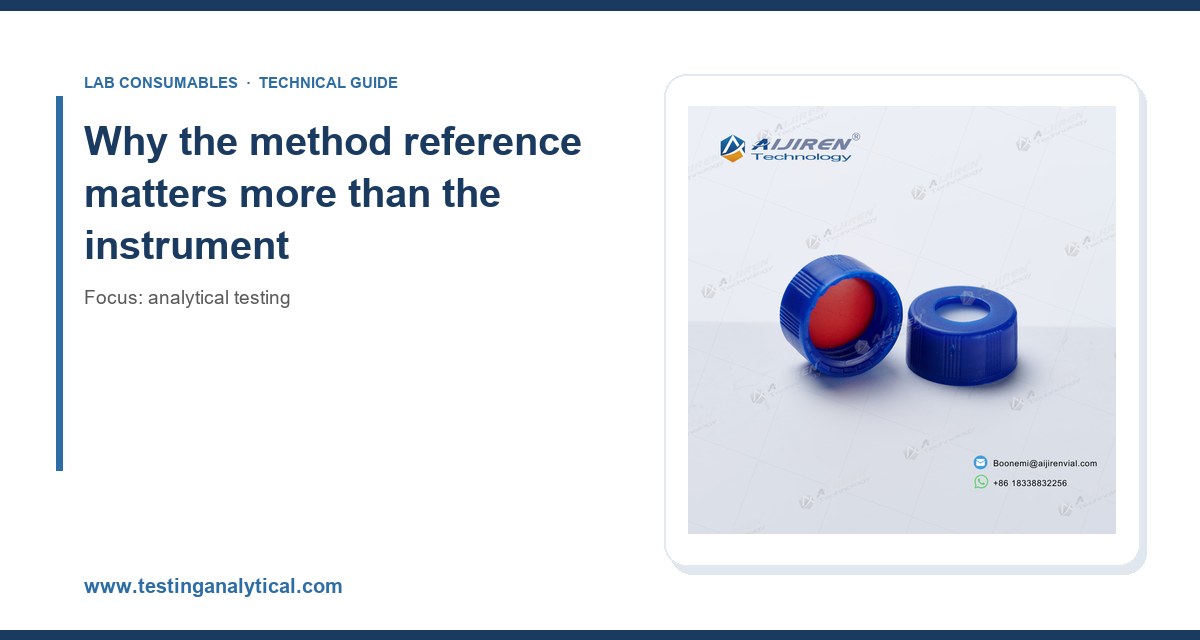
I still remember the day a client’s QA manager rejected a batch of 40 HPLC vials because the certificate of analysis listed “compliance with USP <661>” without stating which part of the test had actually been run. The vials were fine. The paperwork was not. That single omission held up a release of 12,000 units and cost the distributor four days of back-and-forth with the customer’s regulatory affairs team. If you sell, buy, or use analytical consumables in a regulated environment, the method and the documentation around it are inseparable. This article is about the method side: how EPA, ISO, and AOAC requirements shape what you actually do in the lab, what you specify on a purchase order, and how you prove it when an auditor asks.
Analytical chemists tend to obsess over the instrument. The column, the detector, the autosampler. That is understandable because those are the parts that fail visibly. But in a regulated setting, the method reference is what determines whether your result is defensible. A GC-MS run that produces beautiful chromatography is worthless if the extraction step does not match the method, if the calibration range does not bracket the samples, or if the reporting limit is above the regulatory threshold.
Three method families dominate the regulated analytical world, and each one has a different philosophy:
- EPA SW-846 is performance-based. It tells you what the method must achieve (detection limits, precision, accuracy) and gives you example procedures, but allows substitution if you demonstrate equivalent performance. That flexibility is a trap for the unprepared.
- ISO methods (for water, soil, air, food) are prescriptive and internationally harmonized. They specify apparatus, reagents, and procedure in detail. Deviations require documented validation.
- AOAC methods are consensus methods for food and agricultural products, often validated through multi-laboratory collaborative studies. The Official Methods of Analysis carry legal weight in many jurisdictions.
If you are procuring consumables for any of these, the method reference should appear on your specification sheet. A vial is not just a vial when the method says “use amber glass vials with PTFE-lined septa.” The material, the liner, and the dimensional tolerance all become part of the method’s control of variables.
EPA SW-846: performance-based does not mean anything goes
SW-846 is the U.S. EPA’s Test Methods for Evaluating Solid Waste, Physical/Chemical Methods. It covers thousands of analytes across soils, sludges, and waste matrices. The current online compilation is updated through Update VII, and individual methods carry their own revision dates. Method 8260D (volatile organics by GC-MS) and Method 8270E (semivolatile organics) are the workhorses, and both have been revised multiple times in the last decade.
Performance-based method structure
Each SW-846 method contains a procedure, but the EPA explicitly permits alternative procedures provided the laboratory demonstrates acceptable performance. In practice this means you must establish:
- Demonstrated detection limits (DL) at or below the regulatory threshold. For Method 8260D, the laboratory-specific DL must be verified in the matrix of concern, not just in reagent water.
- Initial demonstration of capability (IDOC) with four to seven replicate analyses at a concentration of one to ten times the DL.
- Ongoing precision and accuracy through method blanks, matrix spikes, and laboratory control samples at a frequency of one per batch of 20 samples or fewer.
- Calibration verification at the beginning and end of each analytical sequence, with acceptance criteria typically ±15% for mid-level standards and ±20% at the DL.
The trap I have seen repeatedly: a lab buys a new GC column with slightly different dimensions (say, 30 m × 0.25 mm × 0.25 µm instead of the 30 m × 0.25 mm × 1.0 µm specified in the method) and assumes it can just run the method. It cannot. The retention times shift, the resolution between critical pairs changes, and the IDOC must be repeated. If you are sourcing columns, work with suppliers who publish retention indices and method-specific application notes. Restek’s technical resources are one of the few places I trust for method-mapped column selection, and their application notes often list the exact SW-846 method number alongside the chromatogram.
Consumable specifications that matter for SW-846
For volatile organics (8260), the sample container is part of the method. The method requires:
- 40 mL amber VOA vials with PTFE-faced silicone septa, filled with zero headspace and preserved with HCl to pH <2.
- Septum puncture count: no more than two punctures per septum. After the second, discard the vial. This is not a suggestion, it is a method requirement, and auditors will ask how you track it.
- Storage: 4°C ± 2°C, protected from light, analyzed within 14 days of collection (7 days if not preserved).
I have watched labs reuse VOA septa because “the vial still looked full.” That is a finding waiting to happen. The septum loses its seal after the second puncture, and the headspace expands. If you are buying VOA vials at scale, specify the septum durometer and the cap torque. A 24 mm screw cap on a 40 mL vial should be torqued to roughly 1.5 to 2.0 in-lb; overtightening deforms the PTFE face and creates a leak path. The HPLC vial suppliers who also make VOA vials often publish these torque values, but you have to ask.
For semivolatiles (8270), the consumable story shifts to extraction. Method 3510C (separatory funnel) and 3520C (continuous liquid-liquid) both specify glassware that must be solvent-rinsed with the extraction solvent before use. Method 3546 (microwave extraction) requires vessels rated for the pressure and temperature of the method (typically 100 to 175°C and up to 300 psi). If you are running 3546, the vessel liner is a consumable that must be replaced per the manufacturer’s cycle count, usually every 100 to 200 extractions. Track it.
ISO methods: prescriptive, harmonized, and unforgiving
ISO methods are written by technical committees and voted on by member bodies. They are deliberately prescriptive because the goal is reproducibility across borders. If you are testing drinking water in the EU under the Drinking Water Directive, you are likely working to an ISO method (for example, ISO 11885 for trace elements by ICP-OES, or ISO 6468 for organochlorine pesticides by GC-ECD).
What ISO prescribes that EPA does not
ISO methods often specify apparatus in more detail, including dimensional tolerances. For example, ISO 5667-3 (water sampling) specifies sample container materials, volumes, and preservation. ISO 9308-1 (E. coli and coliforms) specifies membrane filtration apparatus and incubation temperatures to the degree. If your method says “use a 47 mm membrane filtration unit with a 0.45 µm cellulose nitrate membrane,” you cannot substitute a 25 mm unit without a documented deviation and validation.
For chromatography consumables, the practical impact is on the column and the sample introduction. Many ISO methods specify the column chemistry (C18, for example) and the particle size (5 µm). Some specify the column length and internal diameter. If you are sourcing a replacement column, the Agilent chromatography consumables catalog lists the method equivalency for many ISO and EPA methods, which saves you the trouble of cross-referencing the standard yourself.
ISO 17025 and the consumable traceability chain
If your lab is accredited to ISO/IEC 17025, the consumable traceability requirement is explicit. Clause 6.5 requires that you evaluate suppliers and that you verify purchased items before use. In practice, this means:
- Certificate of analysis (CoA) for every lot of vials, septa, and columns. The CoA must state the test method used for the dimensional and chemical checks.
- Lot-to-lot retention samples for critical consumables. I keep two vials from every lot of HPLC vials and run a blank injection on each new lot before releasing it to the bench.
- Supplier audit records for any consumable that affects the validity of results. For a glass vial, the audit can be a questionnaire; for a GC column, it should be a site visit or a documented performance test.
The chromatography consumables supply chain is long, and the CoA is often the only link between the glass manufacturer and your bench. If the CoA does not state the test method, ask for it. If the supplier cannot provide it, find another supplier.
AOAC methods: consensus, collaborative, and legally binding
AOAC International publishes the Official Methods of Analysis (OMA), which are used for food, feed, and agricultural products. The methods are validated through collaborative studies, and the resulting performance characteristics (repeatability, reproducibility, recovery) are published alongside the method. In many jurisdictions, AOAC methods are the reference methods for regulatory compliance, particularly for nutrition labeling and contaminant testing.
AOAC method performance characteristics
When you run an AOAC method, you are expected to meet the published performance. For example, AOAC 2007.01 (pesticide residues in foods by acetonitrile extraction and partitioning with magnesium sulfate, the QuEChERS method) specifies recovery ranges and repeatability limits. If your lab’s recovery falls outside the published range, you have a problem that must be investigated before reporting. The method is not a suggestion; it is the benchmark.
The consumable implications for AOAC methods are significant. QuEChERS, for example, requires:
- 50 mL centrifuge tubes with screw caps and conical bottoms, rated for the centrifugation speed (typically 3,000 to 5,000 × g).
- Disposable extraction kits with pre-weighed salts (4 g MgSO4, 1 g NaCl for the original method). The salt ratio is part of the method; do not substitute.
- dSPE tubes with specified sorbents (PSA, C18, GCB) at specified masses (typically 25 to 150 mg per tube).
I have seen labs try to save money by buying generic QuEChERS kits without the method reference on the box. The salt ratios are close but not identical, and the recovery drifts. For a regulated method, buy the kit that states the AOAC method number on the label. The Thermo Fisher chromatography and sample handling catalog is one of several that cross-reference kits to AOAC method numbers, and it is worth bookmarking if you run a lot of food methods.
Nutrition labeling and the AOAC method lock-in
For nutrition labeling, the method is locked to the analyte and the matrix. AOAC 992.23 (crude protein in cereals and feeds) is not interchangeable with AOAC 991.20 (nitrogen in milk) even though both use Kjeldahl digestion. The difference is in the digestion conditions and the catalyst. If you are a contract lab serving food manufacturers, you need to maintain method-specific capability, which means method-specific consumables. The digestion tubes, the catalyst tablets, and the titration reagents all become part of the method record.
Method selection: a decision checklist with numbers
When you are choosing a method for a new analyte or matrix, the decision usually comes down to regulatory requirement, matrix, and detection limit. Here is the checklist I use, with concrete numbers:
Step 1: identify the regulatory driver
- Waste and soil (U.S.): SW-846. Start with the analyte list in Method 8260D or 8270E, then check the regulatory limit in 40 CFR Part 261 or the state program.
- Drinking water (EU): ISO methods referenced in the Drinking Water Directive. Check the parametric value (for example, 0.1 µg/L for individual pesticides) and confirm the method’s limit of quantification is at least 30% below it.
- Food (international): AOAC OMA or the Codex Alimentarius reference method. Check the maximum residue limit (MRL) and confirm the method’s LOQ is at or below the MRL.
Step 2: match the method to the matrix
A method validated for reagent water may not perform in wastewater. The matrix effect on a GC-MS injection can suppress the signal by 20 to 50% for some analytes. If you are running environmental samples, use matrix-matched calibration or standard addition. If you are running food samples, use the QuEChERS dispersive cleanup that matches the matrix (PSA for high-pigment matrices, C18 for high-fat matrices).
Step 3: verify the consumable specification
This is the step most labs skip. Before you commit to a method, verify that the consumables are available at the specification the method requires:
- Vial: 2 mL clear glass, 12 × 32 mm, 9 mm screw thread, PTFE/silicone septum, 100 per pack. Confirm the septum is pre-slit only if the method allows it (most do not, because pre-slit septa increase evaporation).
- Column: 30 m × 0.25 mm × 0.25 µm DB-5MS or equivalent for semivolatiles. Confirm the column is tested against the method’s resolution criteria (typically R ≥ 1.5 for critical pairs).
- Filter: 0.45 µm PTFE or nylon for aqueous samples, 0.2 µm for LC-MS. Confirm the filter is low-extractable (≤ 0.1% mass loss) and compatible with the solvent.
Step 4: document the deviation
If you cannot meet the method specification exactly, document the deviation and validate the alternative. For SW-846, the validation is the IDOC. For ISO, it is a formal deviation with supporting data. For AOAC, it is a method modification study. The documentation is the method.
Operational precautions: what actually goes wrong
Most method failures I have investigated are not instrument failures. They are consumable failures or documentation failures. Here are the ones I see most often:
Septum coring and the 2-puncture rule
Autosampler needles core septa. A 22-gauge needle on a 9 mm septum will punch a hole that does not reseal, and the next injection will draw air. The fix is to use a septum rated for the puncture count (typically 2 to 5 punctures for a standard silicone/PTFE septum, up to 10 for a pre-slit or a higher-durometer septum). If your method requires zero headspace, you cannot use a pre-slit septum. Track the puncture count on the sample list and replace the vial after the second injection.
Column bleed and the temperature limit
Every GC column has a maximum operating temperature. A 5% phenyl column (DB-5MS) typically has a limit of 325 to 350°C. If your method’s final oven temperature is 320°C, you are at the edge, and the column will bleed. The bleed shows up as a rising baseline and a loss of sensitivity at the high end. The fix is to use a column with a higher temperature limit (for example, a 1% phenyl column rated to 360°C) or to reduce the final hold time. Check the column’s technical data sheet, not the catalog summary.
Vial adsorption and the silanization question
Some analytes adsorb to glass. Basic compounds (amines) and polar compounds (phenols) are the usual suspects. If you see low recovery at low concentrations, try a silanized vial or a vial with a deactivated glass surface. The lab vials suppliers who offer silanized options usually state the deactivation method and the recommended analyte classes. Do not assume that a standard Type I borosilicate vial is inert for every analyte.
Carrier gas purity and the oxygen trap
GC methods specify carrier gas purity (typically 99.999% or better). If your gas supply is 99.99%, you are introducing oxygen and moisture into the column, which degrades the stationary phase. The fix is a gas purifier (oxygen trap, moisture trap, or a combined indicating trap) installed between the cylinder and the instrument. Replace the trap when the indicator changes color, typically every 6 to 12 months depending on gas usage. This is a consumable that most labs forget to track.
Troubleshooting checklist
When a regulated method fails, work through this list in order. Do not skip to the instrument.
- Check the method blank. If the blank is contaminated, the problem is in the consumables or the reagents, not the sample. Replace the vial lot and the septum lot, and re-run the blank.
- Check the calibration verification. If the mid-level standard is outside ±15%, the problem is the calibration or the standard, not the sample. Prepare a fresh standard and re-run.
- Check the internal standard response. If the internal standard area count is down by more than 30%, the injection is failing. Check the syringe, the septum, and the inlet liner. Replace the liner (typically every 100 to 200 injections for dirty matrices) and re-run.
- Check the retention time. If the retention time has shifted by more than 0.05 minutes, the column is degrading or the carrier gas flow is off. Leak-check the inlet and replace the column if the shift persists.
- Check the matrix spike recovery. If the recovery is outside the method’s acceptance range (typically 70 to 130% for environmental methods), the matrix is suppressing the signal. Dilute and re-run, or use standard addition.
- Check the documentation. If the data looks fine but the result is not defensible, the problem is the method record. Confirm the method reference, the revision date, the consumable lot numbers, and the analyst’s training record.
Recommendation: build the method into the purchase order
The most effective control I have implemented is to put the method reference on the purchase order. Every consumable that touches a regulated method gets a line item that states the method number, the revision, and the specification. For example:
- Vial: 2 mL clear glass, 12 × 32 mm, 9 mm screw thread, PTFE/silicone septum, method reference EPA 8260D, lot traceability required, CoA required.
- Column: 30 m × 0.25 mm × 0.25 µm, 5% phenyl, method reference EPA 8270E, maximum temperature 350°C, CoA required.
- Filter: 0.45 µm PTFE, 13 mm diameter, method reference ISO 11885, low-extractable, CoA required.
This does two things. It forces the supplier to confirm the specification before shipping, and it creates a record that satisfies the ISO 17025 traceability requirement. The analytical testing supply chain is full of look-alike products, and the method reference on the PO is the cheapest insurance you can buy.
For labs running multiple method families, I recommend a method-to-consumable matrix. Rows are consumables (vials, septa, columns, filters, syringes, liners). Columns are methods (8260D, 8270E, 11885, 2007.01). Cells contain the specification and the approved supplier. Review the matrix quarterly and update it when a method revision is published. The EPA publishes SW-846 updates on its website, and the ISO and AOAC revisions come through the technical committees. If you are not on the distribution list, you will find out about the revision when an auditor asks.
The regulated method is not a document you file and forget. It is a living specification that reaches into every consumable on the bench. The labs that pass audits without drama are the ones that treat the method reference as a purchasing requirement, not a paperwork exercise. Put the method number on the PO, keep the CoA on file, and track the puncture count. The rest is chemistry.
References & further reading
Related resources from our lab consumables network:
- Analytical Testing at testinganalytical.com
- Hplc Vial at vialforhplc.com
- Chromatography Consumables at chromatographyconsumables.com
- Lab Vials at labvials.com
External references and standards: